
The Labour Line of the (N)CPC
by the Central Committee of the (N)CPC, March 2025
Sections
- Workers’ centrality
- On opportunism, or the “labour aristocracy”
- The importance of unions
- The legal regime
- Union line
- Deviations on the union line
- Organization and intervention
- Forging a revolutionary working class
The exploitation of proletarian labour-power is the primary means by which capitalist society reproduces itself. Every new rent-seeking scheme or financial bubble is built atop a foundation laid by labour-power and the surplus extracted from it. Maintaining and intensifying the daily, hourly exploitation of labour-power lies at the heart of capitalist politics and public life.
Through a process of protracted struggle, the proletariat learned through the 19th and into the 20th century that its hope for gaining an advantage rested on two facts: its overwhelming numerical superiority and its central position in production. Across the capitalist world, workers combined into unions and refined their organizational forms so that they could leverage those advantages to shut down production and hurt their opponents – the capitalists – worse than they themselves could be hurt.
This weapon – the strike – has primarily been used to advance the economic interests of specific workers. As the proletariat grew into political maturity, it learned to use the strike for political ends. It also learned the limitations of strictly economic organizations and, where it was most advanced, combined these with the Communist Party, the United Front and the People’s Army to give itself maximum strategic latitude to conquer political power for itself.
The strength of the communist movement in Canada has always correlated strongly with its base of support among the organized working class – that is, among the unions. This is because revolutionaries have used the occasions produced by the daily conflict between labour and capital playing out in workplaces to lead workers into class conflict, sharpen the contradictions between those two great social forces and win them over to the only method for resolving those contradictions: revolution and communism. It is also because those workers can leverage their place in production by striking to win victories that would otherwise be impossible. The particularities have changed and require serious attention, but these general truths are as relevant for revolutionaries today as they were in decades past.
As an advanced capitalist and imperialist country, Canada has intense specialization of its branches of industry, complex supply chains, a large service sector and a highly interventionist state. All of these have serious implications for how revolutionaries ought to intervene in the primary site of workers’ exploitation – the workplace.1 We therefore need to articulate an analysis of the current situation and lay out a strategy to guide us toward revolution.
Our Party has accepted the monumental dual tasks of defeating the Canadian bourgeoisie and establishing a multinational socialist confederacy. Essential to our strategy for carrying this out is the theory of workers’ centrality. Our purpose in this piece is to make the case for this position and draw out its implications for practice – that is, to articulate a line on the labour movement. This labour line can be summed up as building the proletariat’s capacity to engage in political strikes, or in other words, harnessing its economic power to achieve political goals.
Below we also analyze some of the contending lines within the labour movement,2 both as a way of illustrating our own line in contrast to these, and to point out their flaws and shortcomings, in an attempt to win fellow labour organizers to our positions.
Workers’ centrality
Our political goal is the revolutionary overthrow of capitalism and the bourgeois state, conquest of power by the proletariat, and the establishment of a multinational socialist confederacy. The correct line on unions and the labour movement is the one that best serves these ends.
If we’re serious about taking power, we need a labour line that allows us to do two things: deal substantial blows to capital, and reproduce society under our own direction. Both of these require substantial power and organization in strategic industries. Agriculture, food processing, resource extraction, construction, manufacturing, transportation and utilities are all essential for even the short-term maintenance and reproduction of a modern industrial society. Striking these can threaten the economy of a town, a region, or even the entire country and so the ability to do so will be a vital weapon for the proletariat in both the long development of its struggle for political power and at the decisive moments when it chooses to initiate or exacerbate a revolutionary crisis. The education and healthcare sectors also bring together large numbers of workers and are key factors allowing both the reproduction of the working class and a high rate of labour participation,3 and so can exercise similar power in a more indirect way.
Likewise, running a socialist economy without near-total organization in these industries will be impossible. Socialism will be many wonderful things, but it will not be a vacation. Rebuilding, reorganizing and defending the new society will at times require tremendous sacrifices by the proletariat – including increased production quotas, wage restrictions, and labour-force shortages. Workers will not tolerate this unless they are properly organized to have democratic input into the socialist economy and properly led to see these sacrifices as necessary to their long-term liberation. Counter-revolutionary forces have the same ability to organize these workers as we do, and unless we have organized them first, reactionaries will wield their strikes as weapons against us.
Contrast these strategic industries to other productive industries like food service and hospitality (to say nothing of the massive and parasitic banking, insurance, etc., industries that employ large numbers of proletarians). Such workers have an objective interest in the defeat of capitalism and have everything to gain by our victory, but are not able to exercise the same leverage against capital as a whole, nor are their industries as central to the reproduction of socialism as their counterparts in the strategic industries. Their place at the end of the supply chain also makes them vulnerable to job action in primary and secondary sectors of the economy. They are immediately dependent on inputs from those and so can easily be cut off from raw materials should a struggle escalate beyond a simple economic contract fight.
This is not to say that we should shun organizing workers in retail, food service, etc., altogether. If we recruit someone who is an established leader in a grocery store, there are many benefits to having that person organize a union, fight the boss, politicize the struggles as much as possible and push their central union in a more democratic, militant and eventually revolutionary direction.4 This is a question of where to deliberately deploy our limited forces when we have the opportunity to do so in a premeditated way. In those cases we must prioritize large shops in strategic industries.
To put it bluntly: if we have the mines and factories organized but not the coffee shops, we’ve got a chance at victory, but if instead we have the coffee shops organized but not the mines and factories, we’re doomed. The need for a revolutionary line on unions and labour follows from this reality.
On opportunism, or the “labour aristocracy”
Before elaborating more fully on our labour line, it is necessary to spend some time addressing whether the working class in the imperialist countries, in whole or in part, is even capable of revolutionary consciousness in the first place. This question has fundamental implications for revolutionary strategy in our country so we’ll treat it first.5
The existence of super-exploitation, and subsequently of super-profits, creates the possibility of opportunism among the working class, as some sections of the class (and some more than others) do benefit from those super-profits. Opportunism can only be relevant in a situation where substantial pro-worker concessions can be made without jeopardizing the capitalist system as a whole, and so super-exploitation is a precondition for its emergence. This is not the same thing, however, as saying that these pro-worker concessions necessitate that opportunism prevail even among the workers who benefit from them, or that all workers with a standard of living above the bare cost of reproduction of their labour-power are beneficiaries of these super-profits – a position which was common, either on the level of formal line or implicitly in operational line during the Third Party-Building Movement and in fact to this day among many self-styled Marxist-Leninist-Maoists in the imperialist countries.
This position contradicts the historical record of communist involvement in labour struggles during both the First and Second Party-Building Movements in Canada, and at least the First Party-Building Movement in the United States,6 and underestimates the decisive role played by the subjective factor in shaping workers’ consciousness.
In the imperialist countries, there are a multitude of means by which some workers’ short-term material interests become entwined with those of particular capitalists and with the success of the capitalist system as a whole. High wages, pension plans, profit-sharing concessions, retirement/education savings, union-sponsored investment portfolios, home ownership – the list goes on and on. There is no sense in denying that individual workers stand to gain alongside capitalists in these instances, though obviously to a far lesser extent.
Workers participate in these investments when their wages exceed the bare cost of reproducing their labour-power.7 At present they have no incentive not to do so, especially since the alternative – keeping that value invested in cash – is no less an investment, just one that is guaranteed to depreciate relative to inflation. And this alternative is not even morally superior to investing that surplus into other commodities, as money sitting in a bank will be used to float many times its nominal value in loans by the bank and thus facilitate further exploitation in its own right.
The portion of the working class that has access to this investable surplus is declining, and those who do have less of it than they used to,8 but there remains a large segment of the class that is involved in one or another form of capitalist investment.
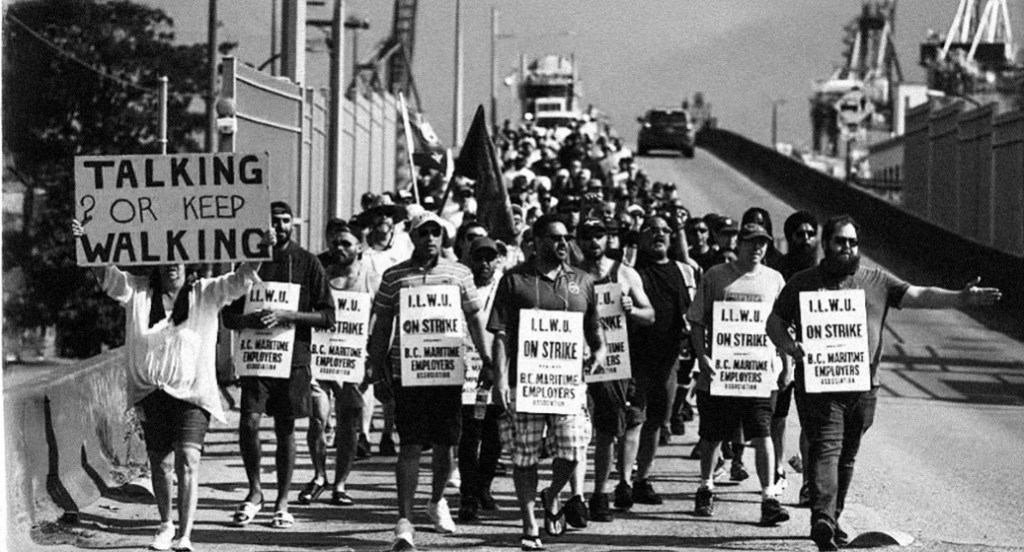
Does this mean that a substantial segment of workers in the imperialist countries are “bought off” and will defend capitalism as a way to protect their meagre gains? To make such a categorical declaration is a mechanistic error. For one, it ignores the insecure and threatened nature of these gains – a Windsor auto worker who loses her job will not find another one with comparable pay, will risk losing her house and pension, etc. Even well-off workers have a long-term interest in ending capitalism to make their material well-being more stable and secure. It also ignores the recent militancy from exactly this section of the working class in recent years (for example, the strikes of auto workers in Ontario, Sudbury miners, dockers in Montreal and BC or aerospace workers from Rolls-Royce Montreal). But even this is not the whole story.
Crucially, this conclusion ignores the decisive role played by the subjective factor: the presence of a revolutionary party exercising leadership within the workers’ movement. Without such a party offering a credible alternative for workers to struggle toward, the only options available are to fight for more within the confines of the system as it exists, or to accept less. Seriously, without a communist telling you how things could be different and how to get there, what course of action would even be available to the overwhelming majority of workers? Notwithstanding the efforts by revolutionaries starting with the “New Left” in the late 1960s through to the second party-building movement of the 1970s and early ’80s,9 this has been exactly the case in Canada since the expulsion of communists from the Canadian Congress of Labour (CCL) and Trades and Labour Congress of Canada (TLC), and in the United States from the Congress of Industrial Organizations (CIO).
The crucial error of the CPUSA during the height of its influence in the labour movement (among industrial workers who were winning substantial raises) was its failure to develop a strategy for actually making revolution.10 We could add that they failed to maintain the capacity for independent labour action. This is what left them vulnerable to expulsion from the unions and subsequent repression following the conclusion of WWII. The failure was on the side of the subjective factor. Did the very same workers who were winning raises under revolutionary leadership in the 1930s really reach an objective tipping point which put them “over the edge” to become opportunists in the 1940s? At what wage rate, or with what social reform, did this quantitative accumulation precipitate a qualitative change? And what is that wage rate today?11 It all falls apart under the pressure of an alternative explanation.
If we take seriously Lenin’s theory that workers will spontaneously only develop trade union (and not revolutionary) consciousness, what other outcome can we expect than for economism and opportunism to prevail among the working class? To put it crudely, communists haven’t been organizing workers and so workers aren’t thinking like communists. Quelle surprise.
The best-off sections of the working class have objective interests that pull them in opposite directions. Even those workers who make a half-decent wage that affords them a few luxuries and investments still have a long-term interest in ending capitalism. The security and fulfillment those things promise will be better guaranteed by a multinational socialist confederacy, to say nothing of the long-term survival of the human species. The same goes for the opposite sides of many contradictions among the people – narrow, short-term interests very often exist in tension or conflict with the long-term interest in unity shared by all sections of the people.
Navigating these contradictions toward their resolution in revolutionary proletarian unity is the task of communists. We cannot use the mere presence of these tensions as a pretext to abdicate our responsibility to win over these sections of the working class – or worse, declare revolution impossible. That would be like saying you can’t climb a hill because the ground is on an incline.
The importance of unions
It will be useful here to lay out clearly and simply the reasons for which we believe unions are an important form and site of struggle for proletarian revolution as a general overview. The caveats, qualifications, and elaborations downstream from these basic points all follow in the text below.
There is a historical tendency toward proletarians combining in organizations to restrict or shut down production through collective action as a means of advancing their economic interests. They are right to do so. This basic perspective of divergent or contradictory interests between themselves and the capitalists who are immediately exploiting them and the stable organizations that give concrete expression to that collectivity are a good starting point for communists to begin work among the proletariat.
Unions can be a place where workers sharpen their understanding of their collective interests and come to understand those interests they share with other workers in the same industry or even the class as a whole. They can also learn the practical skills needed to fight for those interests. Unions are also typically the most democratic organization in a worker’s life that can give them an opportunity to learn the skills of collective organizational life, even if in limited ways.
When economic struggles escalate, they array the forces of capital against the union and provide teachable moments for communists to build the consciousness of the workers in the fight. They also position those workers to strike blows against “their own” capitalists and, depending on the industry and their strength of organization, against capital as a whole.
Therefore, whatever forms they exist in, whatever their particular strengths or shortcomings, unions are a site at which communists must intervene to win workers over to higher levels of political consciousness and practical organization until such time as they are capable of moving beyond their narrow economic struggles and use their unions to wage the political struggles of the proletariat as a whole.
Being the organization that exists at the point of production or circulation, a union can put this consciousness into powerful action by shutting down production, either in pursuit of workers’ economic interests, or, at a higher level, in pursuit of political goals.
Having laid out the abstract, ideal form of our position, we also need to contend with the ways in which reality has deformed this ideal and grapple with what this means for our practice in light of historical lessons and concrete analysis of the present. And so it is now that we turn our attention to the main force in misdirecting modern Canadian unions: the bourgeois state.
The legal regime
Whatever particular adaptations the bourgeoisie makes at the provincial level, the goals of the labour-relations regime are to preserve long-term production and economic growth and to prevent workplace struggles from spilling out to threaten “social stability” (this involves restrictions aimed to limit the scale and tactics of labour struggles and to keep labour struggles focused as narrowly as possible on economic demands). Given a particular balance of forces, it is more advantageous for the ruling class to legalize and tightly regulate labour struggles than to push them all out of the bounds of legality as this turns every economic union struggle into a potentially explosive political struggle, arraying the state in clear opposition to even the basic economic interests of workers.
Pretty much every industrialized country operates within this basic framework, though with wide variation in the particulars. In Canada unions are broadly legal and even respectable social institutions, but only insofar as they accept some of the most strict limitations on their actual power in the industrialized world. “Strikes” are defined extremely broadly as essentially any coordinated12 activity to impede production (including work-to-rule, slow-downs, sick-outs, etc.) and are inherently illegal where there is no legally-recognized union present. Legal strikes are generally required to follow a lengthy process of mandatory negotiation and mediation which must be done in good faith (as determined, in Ontario for example, by the state’s Labour Board) before they are allowed, and not during the life of a collective agreement. “Hard pickets” that physically block entrance and exit from a job site are generally illegal, and in most jurisdictions employers are allowed to hire scabs. Only one union may represent workers from a given unit (the unit being subject to agreement by the union and employer or, failing that, determined by the state). There is very little “wiggle room” and few “loopholes” for labour militants within the law.
When workers’ or unions’ rights are violated, complaints go through the provincial labour boards and typically involve a years-long, expensive process. Take, for example, a company illegally threatening its employees during a certification drive (which they always do), resulting in a narrow loss for a certification vote. The union can file “unfair labour practice” complaints to the Labour Board. Assuming the momentum of the campaign doesn’t die while the legal process is dragged out for months or even years, the remedies offered by the Labour Board in all but the most extreme cases are essentially meaningless for our purposes.13 In those rare, extreme cases they may order the return of employees illegally terminated for union-organizing or even grant unilateral certification to the union, but again these are extremely rare. Most often, proven violations result in nominal fines or mandates that the company publicly acknowledge their wrongdoing in a letter posted in the workplace. The goal of this process is, as hinted above, to kill the momentum of the campaign by diverting resources and attention away from the source of workers’ power: shop-floor mobilizing and job action. Too often, companies are successful in this endeavour. All this means that, even within the framework of restrictions imposed on unions, the system is biased against us. We cannot rely on the system to save us, and it will more often be part of the enemy camp.
We will need to transcend the limitations imposed on unions by the state-sponsored labour-relations apparatus. This is an absolute prerequisite for even basic political strikes, as they are by definition illegal. It is also a necessary component of building class-wide solidarity given that solidarity strikes, secondary boycotts and “hot goods” clauses14 are all outlawed. Even narrow economic strikes come with the threat of legal scab labour and back-to-work legislation, and so if we plan on being successful in those then, realistically, we will also need to be able to systematically violate labour law. A plan and intention to do this will appeal to the most advanced of those still confined by trade union consciousness, as even they suffer under these restrictions (and may have some knowledge of the successful tactics used historically by the labour movement that are now outlawed) and yearn for a restoration of that power.
Recognizing the need to do all this is not the same as having the ability to pull it off, and we would be foolish to pretend that the only thing missing is our own will to do it. Building a labour movement capable of sustained defiance of the state will be a long process of building durable organizations and patient ideological work among the masses of workers, punctuated by opportune moments of upheaval.
As we grow in strength, we will want to start taking on fights and employing methods that transgress the acceptable boundaries of union tactics and union “common sense.” We are not there yet for the most part, but getting there practically should always be on our minds as organizers.
Union line
To develop a correct line on how communists should relate to unions, we need to consider our strategic aims, the objective conditions we find ourselves in and the subjective factors we can bring to bear on the situation. Our current strategic aim is to overthrow capitalism and establish socialism. In order to do this, we will need to be able to lead the proletariat in exercising conscious, coordinated control over production. We’ll need to be able to attack the enemy by stopping production and keep it going once the working class is in charge. To do this, we will need to have leaders deeply integrated among workers in strategic industries. Such a thing is built over time, through shared struggle in such workplaces with cadre shoulder-to-shoulder with workers. This brings us to the question of the unions – how to relate to them, how to use them for revolutionary ends and how to deal with their limitations.
It is a maxim of labour organizing that, when your union becomes threatening enough, leaders will start getting fired. Sustaining a union over time requires you to either build up new leaders to replace them, or reverse the firings by one means or another. Building new leaders takes time and draws from a limited and exhaustible pool of potential worker-leaders. Ultimately, in order to build and sustain a powerful union, you need some way to reverse the firings and get your leaders their jobs back.
The ideal form of this is, immediately upon leaders being fired, the rest of the workers drop their tools and shut down production until the owners concede. This implies an extremely high level of organization and militancy on the shop floor which, under present conditions, takes years to build on the scale required to threaten production in large-scale, strategic industries. It is, for one thing, illegal and in strategic industries would bring down state repression which the union may not be able to withstand. For another, there is a large period of time between the point an organization outgrows secret, underground tactics and the point where it is capable of halting production at will, and during this period leaders – and by extension the whole organization – are exposed to repression by firing, or worse. This opens us up to the need for alternative protections in the interim – namely, the grievance and arbitration process afforded by a collective agreement. Certifying a legal union and securing a collective agreement with even minimal disciplinary concessions (requirement of cause for termination according to clearly-defined rules, a standard of evidence, and progressive discipline) plus a grievance procedure (which in Canada ultimately terminates with binding arbitration by a mutually-agreed third party) is an obvious and necessary tactical bridge to provide protections while we continue to build the power needed to employ more direct tactics.
It is ultimately fantastical to imagine that we could build up organizations in large-scale, strategic industries capable of shutting down production such that leaders and activists can be protected from reprisals without having legal certification as a tactical stop along the way. That’s really only possible in small shops, especially in non-strategic industries where using illegal tactics is beneath the notice of the state. We need a strategy that will work in the mines and factories, not just the coffee shops. We will always need to push the limits of what is possible within the legal framework, circumvent those limitations when possible and prepare to systematically violate it outright at opportune moments – and eventually do so systematically such that the existing legal framework becomes unenforceable in practice. But that is very different than acting as though doing so is on the immediate agenda.
As to whether certification should happen as affiliates of a larger, established union or with a new, “independent” union (presumably led by the Party and its allies from the outset) is a separate question. Treating the old debates about “dual unionism” versus “boring from within” as principled absolutes is an idealist error.15 There are many disadvantages that come with operating outside (and by implication, against) the mainstream unions that are home to the overwhelming majority of organized workers. That said, those are at times outweighed by the disadvantages of working within them. Nothing is easier than to stake out an absolute position on a tactical question and insist upon it at all times and in all circumstances, but we cannot absolve ourselves of the responsibility to make a concrete analysis of the concrete situation.
The objective advantages of the established unions – more resources and density in target industries – decline in their relative significance as the hypothetical “independent” union grows. They also bring with them whole apparatuses of part- and full-time bureaucrats who have, at minimum, made peace with the restrictions imposed on the working class by the labour relations apparatus and their role in enforcing those restrictions (and have, realistically, fully accepted this – more on this later) and who will seek to oppose and undermine our attempts to build a mass-based, fighting, “class against class” labour movement.
All this said, we are not in a strong position to start provoking the enmity of potential middle forces. There is no surer way to get bogged down defending against raids and backdoor deals between bosses and the yellow unions than to set up an independent union. We’re fortunate when we win single-fronted fights; insisting that every fight be two-fronted would doom us.
Trying to build up our influence within the existing unions will mean that we will often, likely be opposed by the bureaucrats. Pursuing “independent” unionism at this stage means that we’ll be opposed by the “yellow” bureaucrats every time, certainly and with far less opportunity to patch things up and move forward with our work intact. More importantly, to the extent that those bureaucrats do actually lead their members, we will set ourselves up in opposition to those workers and their unions, undermining attempts to win them over to our political leadership. Our efforts to win leadership over those workers will be much more effective if they’re spent within those unions drawing more rank-and-file members into action, campaigning for union democracy and militancy, and showing ourselves to be the most dedicated and capable fighters for the class.
There may come a day when circumstances make independent unionism or something approximating it the best path forward, and we see no reason to permanently close off that tactical avenue from this early vantage point, but for at least the foreseeable future this is not viable (and much less advantageous) practically or politically. Nor could it possibly be: independent trade union centres require thousands, or more realistically tens of thousands of members, including established union locals, at their founding to have any kind of practical capacity or legitimacy. And even in such a situation, we will still need forces inside the yellow unions agitating for our positions, obstructing attacks against us and trying to build unity in action between the yellow and red centres. Starting out by forming our own independent or red union centre would preclude any such possibility.
So we will have to dedicate the vast majority of our forces involved in labour work to organizing with and inside the legal “yellow unions,” and this is not likely to change any time soon.16 But doing so comes with its own set of challenges and we have to be clear-eyed about what they are. The state, again, plays a central role in shaping those challenges.
Since the very beginning of legal unionism in Canada in the 1870s, the state has attempted to use legalization to limit the scope and power of unions to exercise power and advance workers’ interests. The state has likewise always used legalization as a means of inserting itself into labour disputes as a mediating force and a check on militancy. That tradition continues to this day, with a labyrinthine system of rules imposed on unions, limitations on what actions they can take and why and the ever-present menace of back-to-work legislation – all enforced by threat of fines and jail time, seizure of assets and unilateral decertification. Generations of labour leaders have, with notable and heroic exceptions, accepted these limitations and have thus reinforced them through practice such that they are now the conventional common sense norms within most unions. The unions are thus accounted for by, and to an extent integrated with, the regime of preventive counter-revolution.
Capitalists, too, have learned to use the unions in many cases to limit or even undermine shop-floor militancy. Predicable contract cycles plus “management prerogative” allows companies to stockpile goods ahead of strikes. Union officers are legally required to prevent and/or stop any unsanctioned job action by their members and thus act as a force for moderation and stabilization of the labour force. This moderating role extends to grievance handling too, both in essence and form. Instead of shop floor disputes being a matter of what workers will tolerate and what they are powerful enough to successfully contest, grievances become a legalistic matter of whether a given subsection of the collective agreement was technically violated. Grievances are resolved in a similarly legalistic way, with the “quickie strikes” of the 1930s replaced by an arduous, expensive process of mediation and arbitration where the role of enforcement is ultimately outsourced to the state rather than the workers and their union.
Politically, the union leadership in Anglo-Canada is structurally integrated with and ideologically supportive of the New Democratic Party (NDP). They have temporarily broken with that party only rarely and only at the provincial level after outrageous betrayals and have always come back into the fold after a few years. In Quebec, a similar relationship exists between the union leadership and both the Parti Québécois (for the old guard) and Québec solidaire (for the up-and-comers). Union leaders’ positions are ultimately supported by state-mandated dues check-off by the employer, and as a result there is a drift toward alienation from their membership. Many are thus more interested in maintaining good relations with the employer than with mass involvement of the workers they represent. Indeed, such mass involvement can be a threat to their careers – not only because mass involvement produces new leaders to compete against entrenched bureaucrats for positions, but because raising workers’ expectations puts those bureaucrats in the uncomfortable position of having to answer for their own failures. Union leaders are by no means a monolith and so while there are many exceptions to this, they will often be the first line of opposition to initiatives in support of worker militancy.
The “closed shop” model imposed in Canada by the Rand Formula17 reinforces this problem by forcing all workers, from the most militant to the most conservative, into a common democratic structure. This keeps leaders in a position of always being vulnerable to reactionary challengers (invariably supported by the bosses or rival unions) if they step too far out of line.
None of these challenges negate the necessity of developing strong unions with revolutionary leadership in strategic industries if we intend to conquer power. Therefore, none of these challenges negate the necessity of communists to navigate this environment and build those unions and establish that leadership. This will be difficult, and we will have to be smart about it.
The difficult but necessary thing is to advance a coherent strategy by all available tactics and to choose specific tactics based on how well they will advance that strategy. But why limit ourselves to working with the legal unions? Why not do that where necessary but also simultaneously work on building independent labour organizations? Can’t we “chew gum and walk”?
It’s easier said than done. Will it one day make sense for the Party to have some of its organizers build union structures completely outside the existing yellow union apparatus? Possibly. It’s happened before. Is that the best course of action for us, today, with our limited number of organizers and limited base of support among the proletariat? No, it would relegate us to the margins of the labour movement and the margins of the working class – as it has done every time it’s been attempted in recent history. To “chew gum and walk” requires not only feet and a mouth, but a sophisticated central nervous system connected to durable muscles and bones. The revolutionary movement at present is simply not developed enough for this.
A revolutionary vanguard party operating with democratic centralism is an indispensable tool here. All the laws, norms and incentives of the labour relations apparatus18 direct us away from building substantial power and away from using that power for political ends. Those organizers will need the leadership of the Party and the ideological and political support provided by the Workers’ Political Mass Organizations (more on those below) to maintain their independence from these powerful forces pulling them toward opportunism. The Party’s labour organizers, particularly the leaders in this field of work, will have to be disciplined to a central plan for making revolution and understand their component part in it. Substituting this with an aggregate of individual subjective assessments by our labour organizers – a sort of ultra-democracy by omission – will doom us.
We therefore propose that at our current stage of development and in our present objective conditions, we must work within existing unions and maintain our political independence through Workers’ Political Mass Organizations and the revolutionary vanguard party. Practically speaking, this means:
- organizing new unions in strategic industries;
- organizing workers in existing unions toward a mass-based, militant, class-against-class perspective including political action and involvement in the mass movement;
- building influence and political leadership within existing union locals, including winning leadership positions in those locals, in order to lead the unions toward political struggle; and
- advancing the use of political strikes by the unions to pursue the interests of the working class as a whole.
Deviations on the union line
It’s important that we illustrate our union line not simply by statement of principle and intention, but in contrast to the other prevailing trends in the labour movement. We will address some of those here, as well as outline how revolutionaries should relate to them.
What we’ve produced here is not meant as a comprehensive taxonomy of the various trends and tendencies in the labour movement. While this would be worthwhile for someone to do at some point, it is not important enough at this stage to warrant the amount of work it would take to produce. Indeed, for some of these tendencies to really show their true nature they would have to be confronted with the practice of a revolutionary labour line – after all, to know the taste of a pear you have to eat it.
On “revolutionary syndicalism”
Though revolutionary syndicalism is relatively small and weak in the present day, it exercises outsized influence among many organizers who recognize the limitations of trade unionism (including progressive and Leftist activists who are sympathetic to, but not active within, the labour movement) and so it warrants significant attention here.
Revolutionary syndicalism is not a single, coherent theory but a broad category that includes a number of trends. In general, it is characterized by an emphasis on:19
- control of unions by workers rather than entrenched leaders or staff;
- suspicion or outright refusal of union staffers;
- tactical combativity as a matter of principle;
- organization of all workers regardless of job class or legal status;
- supremacy of the economic struggle as a means to liberation (up to and including rejection of political struggle by workers altogether);
- avoidance/suspicion/refusal of the state-sponsored labour relations apparatus and of the mainstream unions; and
- worker “self-management” as both a strategic waypoint and ultimate goal.
The most relevant historical examples of revolutionary syndicalism in Canada are the historical Industrial Workers of the World (IWW) and the One Big Union (OBU). In the present day, the perspective is mainly represented by the contemporary IWW,20 though it also strongly influenced the labour initiatives of the Revolutionary Workers Party21 and the “pan-Canadian” PCR-RCP.
There is value in the critiques this tradition levels at the labour relations apparatus and the opportunism of much of the leadership of the existing labour movement. Indeed, it is no coincidence that many of the early members of the Communist Parties of both Canada and the United States were former organizers for the revolutionary syndicalist unions. Unfortunately, this perspective has not lived up to the tasks it laid before itself, and developing an effective revolutionary line on labour requires that we explore why.22
The core failure of revolutionary syndicalism is that it begins with an elevation of tactics to the level of principle. That is because it lacks a coherent strategy for getting from the present day to its goal. As a result, it is unable to make use of a diverse array of tactics, evaluating them according to their ability to advance that broader strategic plan. Tactics are therefore evaluated, at best, according to inconsistent criteria (usually informed by a paranoia about being co-opted), or at worst as simple moral categories. Tactical concessions and compromises are therefore treated as equivalent to strategic compromises and betrayals.23 A few examples will illustrate what we mean.
As we’ve laid out in this document, there is no path between today and the conquest of power that does not involve us organizing and working within the mainstream unions, at least for now. That involves a huge host of tactical compromises and exposes us to many challenges and potential pitfalls (including, we won’t deny, the risk of co-optation). If, instead of trying to figure out a way to successfully navigate this environment, we avoided it entirely as the revolutionary syndicalists do, we would preclude the possibility of victory entirely. We would be unable to build power in large, strategic workplaces. We’d be confined to small shops in tertiary sectors (the only places where these methods have been successful in recent history) and would, at the absolute maximum of success, be smashed practically (economically and militarily) by capital and the bourgeois state as they would still control the critical levers of production.
The same principle holds for full-time organizing staff. The sheer quantity of time, effort, thought and attention required to build and maintain a durable union in a large workplace (especially under conditions of repression) is simply beyond the capacity of people working real full-time production jobs to sustain in the long term. This is not the same as saying that staff should be exempt from democratic controls, that they should be invested with outsized decision-making power, or even that they don’t risk developing interests and perspectives that are against those of the workers. Those are real concerns, and our responsibility is to figure out how to navigate them24 because the alternative – simply refusing to have full-time organizers and staff, or even just minimizing their use – effectively means abdicating our responsibility to organize unions in those large, strategic industrial sites.
We see this again in debates about “contractualism.”25 Even outside large, strategic workplaces, there are obviously situations where the best course of action will be for a group of workers to accept a contract, including one with a no-strike clause (as is legally required in Canada). It may not be ideal, but it may be the best of the realistic and available options for any number of reasons (for example, the alternative may be the total defeat of the union and the scattering of its members to the four winds). It may also be a mistake. It is the difficult job of the movement and its leaders to actually evaluate the concrete situation and find the best path forward rather than abdicate the responsibility by retreating into facile statements of principle.
Historical lessons of revolutionary syndicalism
The historical experience of revolutionary syndicalism in North America has been mixed. It has included heroic highs – for example, the Winnipeg General Strike of 1919 which was led by revolutionary syndicalists. Revolutionary syndicalism was the leading force organizing unskilled industrial workers as well as women, immigrant and Black workers at a time when most mainstream unions largely refused to do so. It was revolutionary syndicalism that was the impetus behind the mainstream unions beginning to organize on an industrial rather than craft basis (indeed there is a living connection between revolutionary syndicalism and the communists who successfully campaigned for amalgamation on an industrial basis within the mainstream unions and who later formed the CIO and made industrial organizing the norm in North America). Revolutionary syndicalism first articulated many of the criticisms of the mainstream labour movement and its leaders (their class collaborationism and their national chauvinism most especially) that continue to inform revolutionaries to this day.
All this credit given, there is a reason it ultimately failed historically and even more reasons why it continues to do so today.
We can attribute the success of the IWW (and to a lesser extent the OBU) in the 1910s to three main factors. First, the refusal of the mainstream unions to organize unskilled workers, immigrants, women and Black people provided a material basis on which to build these unions and the political space for them to operate. Second, without the example of the Bolshevik Revolution as a model for taking power and a Communist Party promoting the same, the shortcomings of revolutionary syndicalism were not yet apparent (or at least they weren’t settled questions) and so it could still attract the most militant class fighters. Third, industrial unionism as an organizational principle was better suited to fighting capitalists in the increasingly large, de-skilled industrial plants than the petty craft unionism on offer by the AFL/TLC, and so they could operate in large plants with a clear competitive advantage against the craft unions. As soon as these three factors ceased to exist, so too did the historical need for these unions, and as a result they were never able to reach anything approaching their former glory.26
Revolutionary syndicalism is averse to developing the all-around (i.e., economic, political and military) power of the proletariat and all it will entail in terms of organizational forms and the shape of society after the capitalists are defeated (the party, a regular professional people’s army, the proletarian state and suppression of the counter-revolution). Revolutionary syndicalists are therefore forced to reverse-engineer a revolutionary strategy containing none of these, and the results are generally a muddle of quasi-pacifism and wishful thinking. Take, for example, the oft-quoted comment by “Big Bill” Haywood from his time as an IWW organizer: “If the workers are organized… all they have to do is to put their hands in their pockets and they have got the capitalist class whipped.”27
Think about that statement for a moment. Think about it in light of the century of war and massacre against workers who were unable to defend themselves militarily since these words were uttered, from Berlin to Jakarta. Do we really just have to “put our hands in our pockets?” Of course not. Believing this statement requires fantastical thinking whereby the entire working class, plus the volunteer army of the capitalist state, is organized wall-to-wall such that massacres won’t be carried out, police columns won’t escort scabs (or soldiers!) into essential war production facilities, and foreign imperialists won’t do the same. The ruling class would never let things get to such a point without intervening with all its might well beforehand.
Haywood was not alone in this error; it is characteristic of revolutionary syndicalism. We are not the first to make this observation. In 1935, Alexandr Lozovsky criticized French anarcho-syndicalist George Sorel for this very error: “Rejecting the state, and the necessity of the Dictatorship of the Proletariat, Sorel came to reject armed uprising; in the place of uprising he called for strike action with ‘folded arms.’”28
Consider, too, the revolutionary strategy (really, a slogan not a strategy) so popular within the contemporary IWW: “Build the General Strike!” This too has deeper roots in revolutionary syndicalism. Again to quote Sorel, “The theory of catastrophe… is absolutely compatible with the general strike, which for the revolutionary syndicalists marks the advent of the future society” [emphasis ours].29
General strikes are great as tactical interventions before, during, or even precipitating a revolutionary situation. They are not, however, a substitute for successfully waging a war against the capitalist state. Civilians with, at most, minimal militia training in defensive operations30 are unable to overcome a disciplined army of regular soldiers or militarized police and hold territory for very long. This was true in 1919 and it’s even more true today. Minimally, you need some kind of professional military formation and a political centre (that is, a party) to lead it. Anything less is suicidal.
The regime of preventive counter-revolution has continuously adapted itself since the heyday of the IWW and OBU, and the methods those unions used to organize large, strategically-placed unions are effectively dead on arrival. It is not 1911 anymore. The state-enforced “closed shop” is an effective reality, and unsanctioned job action is grounds for dismissal and legal action31 which none of us is in a position to withstand at present. These are the objective conditions in which we are organizing, and our strategy needs to be adapted accordingly.
While we disagree with their perspectives on the strategic and political level, we do share a lot of common ground with revolutionary syndicalists, and many contemporary organizers from this tradition are more energetic, dedicated, skilled and insightful than even many progressive trade unionists.32 Revolutionary syndicalists have an abiding trust in the intelligence and energy that masses of workers are capable of exerting, if properly organized, and a firm commitment to rank-and-file democracy. We will often have cause to ally with them and where possible we should undertake comradely struggle to win them over to our line, which is more comprehensive politically and better suited to actually defeat the bourgeoisie, conquer political power and, eventually, “abolish the wage system.”
On trade unionism
Standing opposite to the ultra-left “revolutionary syndicalist” error is its conservative counterpart: trade unionism.33 There are “left” (or “progressive”) and “right” (or “conservative”) wings with corresponding differences in strategy and organizing style, some of which will be treated separately later on. For now, we will focus on the similarities between both left and right wings of trade unionism.
Across the board, “trade unionism” is characterized by an abiding acceptance of the capitalist system as essentially permanent. Revolution and socialism are, for the trade unionists, either impossible or downright undesirable. As Lenin illustrated in Proletarian Revolution and the Renegade Kautsky, this essential, general error is the starting point from which opportunists reverse-engineer their whole strategic outlook, giving rise to further errors when they put it into practice. In the case of trade unionists, this is often manifested as some combination of:
- accepting a narrow role for unions as simply bargaining over the conditions of sale for labour-power;
- conceding control of production to management, and accepting capitalism as permanent rather than fighting to overcome it;
- respecting the legal limits imposed on unions’ tactics (bans against “hard pickets,” solidarity strikes, no-strike clauses, etc.) and further, actually believing in the legitimacy of the state;
- defusing worker militancy by channeling anger away from shop floor action and toward labyrinthine legalistic and electoral strategies;34
- neglect of organizing the unorganized into powerful unions;35 and
- focus on the narrow sectoral interests of their members rather than the class as a whole.
It should be obvious on its face that this perspective is unsuited to build the class-wide unity and militancy required to carry out political strikes, much less revolutionary ones. This should come as no surprise as this is not the goal of trade unionism.36 However – and this is of great interest to revolutionaries – trade unionism in North America has been a failure on its own terms as well.
Trade unionism, especially its more conservative and bureaucratic strains, has been losing a defensive war for over half a century. It is uncontested in its dominance of the labour movement in North America, and so we can fairly judge it by its results. By any objective measure, trade unionism is leading the labour movement into obscurity and defeat.
The erroneous trade unionist perspectives outlined above can actually worsen the contradiction between union leaders and their members. In this framework it is the union leaders first and foremost telling the workers that they must accept defeat in whatever form it takes – stagnating wages, work speed-ups, provocation from management. Rather than direct workers’ anger toward efforts that might overcome the limits placed on their power by the system of labour control, conservative trade unionists develop contempt for the workers or maybe try to recruit them to some hopeless electoral campaign.
For all this, trade unionists are usually the face of the union to the workers and even basic “servicing” (handling grievances, bargaining, etc.) allows them to build goodwill, influence and leadership among the workers over time. For all their failures and shortcomings, the union is often the most democratic institution in a person’s life. It’s also the only organization legally bound to “fairly represent” them, to represent their interests as workers, however inadequately they may do so. For many workers, including many of the formal and informal leaders we will have to win over, this has tremendous importance. They see loyalty to their leaders and defence of their union as one and the same thing. In many circumstances, then, gaining influence in unions led by conservative trade unionists requires patience, tact, diplomacy, and a willingness to “prove oneself” to the workers as a competent and dedicated fighter for their interests. Simply running an opposition campaign to denounce the bureaucrats will end in failure or at best entrench a powerful conservative opposition bloc within your local.
Generally, the advanced forces in a unionized shop will gravitate toward involvement in the union. Doing so implies at least a nominal belief in collective rather than individual solutions to workplace issues, commitment to the interests of workers “as workers” in opposition to management and a willingness to put work in to improve other people’s lives. Notwithstanding this, it is possible to find potentially advanced elements in a shop among those who have nothing to do with or even actively dislike their unions when we first meet them, as well as among those who are already trade union activists. The benefits and drawbacks of trade unionism cause both to occur naturally as part of the incoherent and idiosyncratic politics developed by a class without revolutionary leadership.
To their credit, the progressive trade unionists will try to channel workers’ anger into struggles within the bounds of the existing system, sometimes even attempting to organize mass participation in those efforts – though almost always directed toward economic bargaining with their employer and nothing beyond that.37 This difference is relevant to us as revolutionaries and there is sometimes enough common ground with these progressives, at least at the tactical level, that we can try to build alliances with them.38
We should bring these progressives along with us as far as they are willing to go, but we also need to be careful not to liquidate our capacity for independent action. Historically, labour progressives have variously allied with and opposed revolutionaries, most spectacularly in founding the Congress of Industrial Organizations alongside the American (and later Canadian) Communists, only to expel them from the same union a few years later.39
There are union activists, leaders, and staffers who want to overcome the erroneous “trade unionist” line but are for one reason or another unable to break out of the limitations imposed by this way of thinking and its enforcement in their unions and the whole labour relations apparatus. They will agree with every single one of our criticisms of the existing labour movement and may even call themselves “socialists” or “revolutionaries” but they will, if left on their own, spend entire careers committing the very errors we criticize. For some genuinely well-intentioned people working within the unions, the main barriers are the fact that up until now there has been no revolutionary line on labour, and no movement guided by this line to meaningfully “call the question.” The failure so far is ultimately ours, as revolutionaries, to produce this.40 Again, without a party bringing forward revolutionary politics until very recently, we can only expect trade-union consciousness to have prevailed.
Our organizers need to master the art and science of united front work with progressive forces inside the labour movement and with all possible forces in the labour movement against capital. We need to operate somewhere between “united front without compromise” and “united front at any cost” – again, two easy but useless absolutes.
Organization and intervention
Having laid out our general understanding of the labour movement and its situation in an overall revolutionary strategy, it is necessary to lay out the specific forms our interventions should take. Given the general state of disorganization among communists, labour militants and, subsequently, the working class more broadly, most of this work will involve building new organizations or strengthening existing ones. They are laid out here from those with the broadest bases of support to the most specific.
Organize unions
When we talk about working “within the unions” we obviously do not mean that our only way of doing so is to go get jobs at places that already have unions. We also need to “organize the unorganized” in massive numbers. Of the strategic industries identified above, only three (health care, education and utilities) have even a bare majority of workers unionized. For most others, it’s between 20% and 40%, and for agriculture it’s less than 4%.41 One way or another this will have to change if we’re serious about defeating capital.
Of course, when we say “organize unions,” we mean more than simply winning a certification drive. We want to organize democratic, fighting unions that are a means for workers to build power on the job and ultimately in society as a whole. This means using strategies that rely on mass participation of workers, a basic class-against-class outlook and militant determination in the face of the enemy. Doing this well will mean a combination of proper organizing methods during a drive, proper selection of union affiliation, and maintenance of democratic committee structures after certification. It is a lot of work, and we will have to be smart about it.
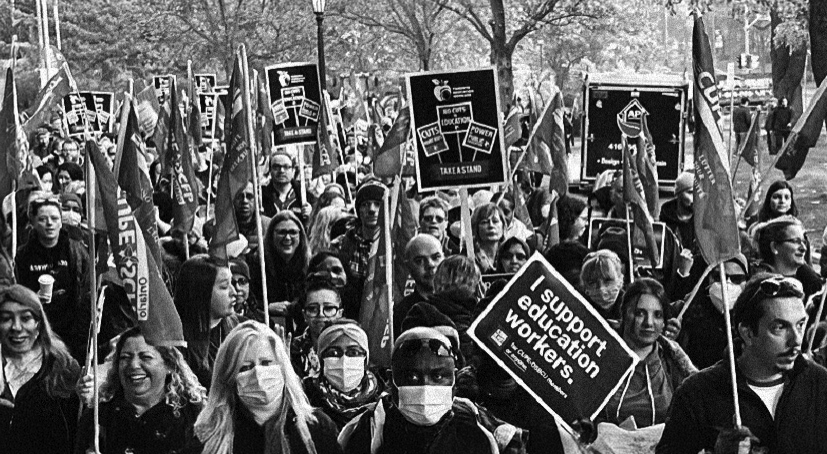
Communist union organizing is similar in its mechanics to what most progressive trade unionists and “revolutionary syndicalists” practice – in fact, both of these will often explicitly trace the lineage of their organizing methods to the Congress of Industrial Organizations (CIO) as a means of legitimization. It is essentially a process of identifying organic social leaders and recruiting them into a committee that can lead the whole workplace. Within that broad overview are a number of skills and strategies which are not often spontaneously present among the people willing to be union organizers, but they absolutely are teachable.42 While there are roles to play for people who are not good organizers, a solid corps of skilled and experienced union organizers must be the backbone of our labour efforts. This in turn means that most organizers will also need to be teachers and mentors of each new crop of new organizers. Organizers need to be force multipliers.
Organizing a large industrial shop takes time, effort and resources. Militants who go get hired at a target shop in order to organize are an indispensable force in these fights.43 The daily face-to-face contact and shared burdens between these militants and their co-workers allows them to form strong bonds with the workers, accurately identify their leaders, assist in recruitment to the union drive and give credibility to the most advanced ideas being brought forward in the course of the struggle. There may be no better training for communist militants in the discipline and basic organizing skills required of us than to salt for a couple years before “implanting” in the newly-organized shop – nor a better way for communists to dig in and build up a base of support among the proletariat.
Such militants alone, however, are not adequate for a successful union drive at a large shop. There are hard limits on how large a structure a person can lead for an extended length of time while also working a full-time production job. A very good leader can do this with perhaps 50 workers (seven sub-leaders, each leading their own group of roughly seven workers). Beyond that, there simply aren’t enough hours in a week to keep up the necessary “background work” (one-on-one meetings, processing information and planning, following up on tasks) to sustain and grow such a structure. Things get neglected, and people fall off. All this is before taking into account the scheduling challenges posed by having 40+ hours a week spoken for on the part of both the organizer and the workers they’re leading.44
At a certain point, the need for full-time external organizers is unavoidable. You need people who are essentially available around the clock (with cars!) to distribute propaganda, recruit workers and lead them through the day-to-day minutiae of the drive, think through the strategic problems of the campaign, interface with the union apparatus that will do the necessary filings, etc. It’s a lot of work, and it has to be done. It also puts those organizers in a position to exercise outsized influence over the campaign and run it according to their own interests rather than those of the workers themselves or to lead it down an erroneous trade unionist path. Communists, then, need to be equipped to struggle with staff organizers and win the workers over to our positions over a variety of issues, including:
- reliance on action by workers to combat management repression rather than retreating into the endless and demobilizing process of legal complaints;
- tactical escalation rather than capitulation;
- democracy within the structures of the organizing drive, within the limits imposed by a prolonged secret phase; and
- commitment to see the fight through to victory rather than “cutting and running” when the challenges of the campaign make the union’s cost-benefit analysis turn against it.
Once a union local is certified and it has its own democratic leadership structure, we will similarly have to be prepared to struggle over these questions (and others outlined in this document) with various staffers and representatives from the larger union apparatus. None of this will be easy or fun, but it is no less necessary, and we need to be prepared to struggle intelligently.
While we reject the theory that the “labour aristocracy” comprises a large portion of the working class in Canada who are so materially invested in imperialism and its spoils that they are bound to be an obstacle to revolution, this does not preclude us from recognizing that the working class is stratified and that there is a material basis for conservatism among the upper strata – especially absent revolutionaries to organize them around an alternative. This has long been the case among skilled, credentialed and higher-paid sections of the class. These also happen to be the most densely unionized sections of the proletariat, and the opportunism that guides almost all unions today consolidates that opportunism among them.
This gives added urgency to the task of organizing the unorganized. Influxes of raw, poorly-paid workers forged in the fire of certification fights and looking to win improvements to their dire conditions of work will be essential to changing the balance of forces within the unions. Led by communists, these workers can be a force for the transformation of those unions. Winning certification fights can likewise give communist leaders an opportunity to prove themselves within the labour movement, with this demonstration of seriousness and competence serving as a basis on which to build influence. Of course, we do not simply organize unions for their own sake. We organize them in order to exercise power.
Striking
An important means by which the proletariat exercises power is through its control of production. Exercising power through control of production means one of two things: producing when production is organized in the interests of the proletariat and shutting down production when it is organized in the interests of capital. The former may occur to a limited extent prior to the proletariat’s seizure of state power (for example, diverting resources from capitalist enterprises to revolutionary forces), after which point it will be the norm. Until then, the proletariat exercises its economic power to pursue first economic, then political and eventually revolutionary objectives by shutting down production – by striking.
Strikes serve several important functions beyond just their use as a weapon by the workers to win concessions. Strikes clearly array the forces of the workers against the whole economic and political apparatus of the bourgeoisie – that is, management as well as the bourgeois media, the police and the politicians – and so demonstrate to the workers a clear division between themselves and their enemies. Strikes demonstrate to workers a degree of the power they can collectively exercise, thus instilling in them a sense of collectivity and a confidence to press forward in pursuit of more ambitious goals. Sustaining a strike requires the creation and coordination of auxiliary/reproductive, logistical and even limited coercive apparatuses, which serve as limited functional organs of workers’ power.
Effective strike tactics also draw in forces from outside the struck shop – in fact, this is a vital component of not just political strikes but even simple economic strikes where production-halting mass pickets must be sustained for weeks or months in the face of state repression. This necessitates broader political work (for example, by a Workers’ Political Mass Organization) both to lay the groundwork for this mobilization and to actually carry it out when the time comes. This, too, will array friends and enemies for all to see and provide material verification of our agitation for a class-against-class perspective among the workers.
These all contribute to favourable objective conditions for the development of a revolutionary class consciousness. Converting that potential for the development of revolutionary consciousness into a reality depends on the effective intervention of the subjective factor – on revolutionaries – and their ability to earn ideological and political leadership among those workers.
While it would be incorrect to say that it is always a good idea to strike, striking does have inherent value for us as communists. One of our jobs as communists, therefore, is to create the conditions for striking to be advantageous. Every contract negotiation is an opportunity to push the contradictions between the workers and capital to their sharpest. Further to this, strike-readiness is a capacity that needs to be maintained through use: the best way to ensure you won’t be strike-ready is to not strike.
The ultimate, long-term aim of our labour line is for the proletariat to use its economic power to carry out revolutionary strikes – that is, strikes aimed specifically at provoking revolutionary situations and materially weakening the bourgeoisie to facilitate their defeat by the revolutionary forces. We are a long way from this. A meaningful step along the way is for the proletariat to use that economic power to pursue its political goals – or in other words, political strikes. These are illegal in Canada, so even getting to the point where workers can pull them off will be a massive, long-term undertaking and will require that we have strategic coordination across regions and industries as well as a robust propaganda apparatus.45
Political strikes will pull unorganized workers into political life as they see the strike fight for their interests, investing them in the strike’s success. Workers will also be forced to clarify their political priorities. This creates a dialectic with the Party whereby important information on the class’s interests can be gleaned and opportunities for the Party to exercise political leadership emerge. And in the best scenarios, political strikes can win concessions which materially change the balance of forces in favour of the proletariat.
In all things, our tactical decisions are subordinated to and in service of our strategic aims: to build up the power of the working class, especially industrial workers; to implant the Party in that sector and develop its leadership within it; and to bring industrial proletarians into the Party for the purpose of using their economic power as a weapon in a more general war for the overthrow of the capitalist system and its replacement by the dictatorship of the proletariat.
Whatever the shortcomings of the First Party-Building Movement, it is indisputable that their interventions in the labour movement far surpassed anything we have seen since, and much of the guidance given to revolutionaries working in the labour movement in those days remains valid, or at least serves as a useful point of departure, for revolutionaries today – especially at the level of tactics. William Z. Foster’s American Trade Unionism,46 a compilation of his writings spanning a little over two decades, serves as a time capsule of sorts for exactly this guidance. All the tactical advice we cite from that body of work is underpinned by a few firm principles:
- the power of workers comes from their vast numbers and their ability to shut down production;
- exercising that power must be a truly democratic and participatory process for the workers involved;
- workers must rely on their own power (not those of the state, the bosses, etc) to advance their interests; and
- when workers are properly organized, they have tremendous bravery, endurance and creativity.
When these principles are put into the everyday practice of labour work, they should have the following characteristics or should be guided by the following principles:
- All decisions regarding strikes must be in the hands of the workers themselves rather than through official intermediaries. This includes starting and ending strikes and also the bargaining process before and during a strike.47 48
- Avoid arbitration as much as possible, and if it can’t be avoided then strive to settle as much as possible in the workers’ favour before arbitrating the rest, as this process is stacked against the workers and by its nature takes the workers and the power they can exercise out of the fight.49
- Enforcement of contract terms is an ongoing fight. Employers “sign [contracts] when they must and violate them when they can.”50
- Industrial unions should try to secure national agreements that cover the whole industry. This is important because it prevents employers from moving operations to cheaper regions of the country, it brings a wider swathe of the class into the struggle along clear lines of workers vs capitalists, and by virtue of involving a whole industry it calls out for political answers.
- Different unions with the same employer or in the same industry should try to line up their contracts to expire at the same time.
- Contracts should be short (around 2 years at most).51
- Strikes should be a majority decision made through democratic channels, not unauthorized minority actions.52, 53
Workers’ Political Mass Organizations and caucuses
Political strikes cannot happen in a vacuum. For an inherently illegal strike over a political demand to have a chance of success, that demand needs a strong base of support among the working class as a whole, the class needs the organizational means to mobilize in support of that strike, and indeed they need to see the strike as an extension of their own fight for the demand. There is no question of evading repression legalistically, and even less of doing so militarily, for a long time to come. Our only shield is the support of the people.
Our union work is decidedly focused on workers in the strategic industries required for the daily reproduction of capitalist society, but our political program is in the interests of the working class as a whole. Building Workers’ Political Mass Organizations allows us to link these two streams by which we organize “workers as workers.” Conditions for the proletariat are deteriorating rapidly, and so there is no shortage of demands around which these WPMOs could be organized: rent control laws, improved social services, labour law reforms,55 the list goes on. As the movement grows and WPMOs proliferate, so too will the demands they organize around.56
In the shops, we will agitate against the inadequacy of striking over purely economic demands. Outside the shops, we will agitate against the inadequacy of having political demands that we aren’t striking for.

The caucus,54 on the other hand, is a body meant to organize advanced workers in a shop to influence their union, run slates of candidates for leadership and where appropriate take action outside the official labour relations and union apparatuses (for example, organizing a wildcat strike).57 The generally appropriate level of political unity should roughly approximate the medium-term goals of our labour work: rank-and-file democracy, a class-against-class perspective and emphasizing the need for the working class to use strikes as a means of exercising political power.58 A caucus should be made up of rank-and-file workers as well as stewards, committee members and officers who uphold and advance the perspectives of the caucus. A caucus should have its own internal democratic leadership structure and division of labour with dues-paying membership and should ideally be organized along industrial rather than union-specific lines.
Caucuses are potentially useful whether party members formally lead the union apparatus or not. The purpose of a caucus as we conceive it is: to influence the official apparatus of the union by various means, to build a base of support for rank-and-file democracy and class-against-class militancy, and to carry out action independent of the union apparatus. They serve to help militant union leaders carry out that militant agenda and act as a democratic check on leaders who may be tempted toward capitulation. They are also a tool for carrying out the class struggle regardless of changes to the labour relations apparatus. For example, if the Rand Formula was scrapped and “open shops” became the new law of the land, caucuses would form the initial organizational backbone of our new, “post-Rand” unions.
Even in a situation where party members and mass activists under their leadership have a total monopoly on official positions in the union, the mandatory closed-shop and dues check-off means we’re bound together organizationally – and democratically accountable to – even the most conservative elements of the workers. This both incentivizes a drift toward the centre for labour radicals who must try to avoid a reactionary revolt among their constituents and necessitates an effective counter-weight to the conservative forces. The caucus can fulfill both functions, provided it has an active membership beyond the elected leaders themselves.
A caucus cannot simply be a slate of candidates for leadership. It can run or endorse a slate, but in order to be fully effective it needs to recruit an active membership beyond that. Producing agitation and educational material, building alliances with progressive and revolutionary forces outside the shop and winning organic leaders over to the caucus’s agenda are all mainstays of its work. It also needs to produce propaganda and make interventions within the union under its own auspices.59
While caucuses will most often have their origins within specific shops, we should be trying to build them into bodies covering entire industries – both by unifying individual workplace caucuses operating in the same industry and by initiating them outright using workers organized outside the shops in the WPMOs. This will eventually allow us to coordinate industry-wide action across different unions and make impactful interventions in the larger workers’ movement.
The caucus is the living organizational link between the Workers’ Political Mass Organizations and the workers in the shop. It will be the body that endorses the demands of the WPMOs, imports them into the union and agitates for them more generally. In situations advanced enough to support it, they will even affiliate openly to the WPMOs and constitute its labour wing.
Workplace cells
The workplace cell is an organizational unit of the Party consisting of the members who work at a particular shop – further subdivided as necessary down to the department or even work-unit level. It is responsible for planning the Party’s interventions in the shop and the union and is the first body to which its members are responsible. The cell is not an independent body but is a subordinate part of a larger branch. Nor is it necessarily the only Party unit involved in a given shop struggle, as propaganda and auxiliary responsibilities could be delegated by the branch to other cells. It is, however, the body that Party members directly involved in a shop struggle ought to belong to (including, depending on the circumstances, external organizers). The presence of the party fraction is vital to developing our work.
There is simply no substitute for having comrades you see eye-to-eye with working on the same immediate project as you are. Being able to fully “let your guard down” politically, talk openly about recruitment prospects and explore the absolute most advanced perspectives on the issues at hand is extremely helpful in synthesizing the correct line to take back to the workers in the shop. You need the space to talk openly about tactics, slogans and long-term plans that may be on or beyond the edge of what you’re capable of actually leading people into at a given moment. If you don’t have that, it’s too easy to fall into either conservative or adventurist subjectivism. At the same time, simply bringing up these topics with people who aren’t ready to talk about them can damage your leadership and credibility in the shop. This is the unique benefit of having a workplace cell in the shop.
The presence of a workplace cell also makes the party immediate and pertinent to those advanced workers who are party-ready. It minimizes the perceived tension between contributing time, energy and attention to Party work vs. union work when the two are more functionally united in this way. As a result, workplace cells help the Party grow among the industrial proletariat and also strengthen the proletarian contingent within the Party.
The workplace cell also serves to reduce the gap between decisions made by individual labour leader/party members and the central plan of revolution. It functions both to break the spell of individual subjectivity in determining the correct course of action in a given shop (which is often a matter of judgment calls regarding granular details only comprehensible to those on the front line) and as the immediate enforcer of discipline to the central plan on organizers and leaders. Workplace cells will be the “cogwheels” by which the Party can exert influence over, and eventually lead, the union apparatus.
Building these workplace cells is therefore fundamental to workers’ centrality on both the tactical and strategic level. Care must be taken, though, that the workplace cell not become the place where the work of the union itself is planned. This creates confusion among the rank-and-file as they sense decisions are being made behind the scenes of their formal democratic structures. What’s planned by the cell is the Party’s interventions in the shop and the union.
In situations where the goal of establishing workplace cells is not yet feasible, a cell can be established for comrades organizing in a given industry, sector or industrial district as the situation allows. They should be working toward establishing workplace cells and in the meantime leading the work of the party’s labour organizers under its jurisdiction.
Forging a revolutionary working class
The (N)CPC’s labour line places workers’ centrality at the centre of our strategy to forge a revolutionary class. Our line reaffirms what communists knew and practiced in the First and Second Party-Building Movements in Canada: that workers can exert tremendous power because of their place in production and circulation, and this economic power must be harnessed by the Party toward revolutionary political aims. By staging battles on shop floors and developing the organizational capacity of the class in workplace cells, caucuses, unions and Workers’ Political Mass Organizations, communists lead workers into direct class conflict. We build and politicize the economic struggles of workers until we’re capable of waging political strikes, treating every picket line of every strike as a novel training ground for class fighters and new revolutionaries. We need to develop both these subjective forces and the objective organs of proletarian class power in order to prepare the longer-term possibility for revolutionary strikes that could, at some future date, meaningfully shift the balance of forces.
To get where we want to go from where we’re at, we must orient communists back into the labour movement and regain ground that has been eroded for more than 40 years. As we operationalize this line through practice, we will contend with the opportunism of labour aristocrats – those bureaucrats employed by or adjacent to unions who have lost allegiance to their class and stifle the combativeness that erupts from workers as conditions continue to worsen across all sectors and industries. We must also become astute at struggling against opportunism, both right- and “left-” varieties, within the class itself and increasingly move advanced workers to see the necessity of revolution and communism. This is a political and ideological struggle necessary to forging a fighting class. There will be no shortcuts – let’s get started.
Bibliography
Bevins, Vincent, The Jakarta Method: Washington’s Anticommunist Crusade and the Mass Murder Program that Shaped Our World. PublicAffairs, 2020.
Burns, Joe, Class Struggle Unionism. Haymarket Books, 2022.
—-, Reviving the Strike: How Working People Can Regain Power and Transform America. Ig Publishing, 2011.
—-, Strike Back: Using the Militant Tactics of Labor’s Past to Reignite Public Sector Unionism Today. Ig Publishing, 2014.
Camfield, David, Canadian Labour in Crisis: Reinventing the Workers’ Movement. Fernwood Publishing, 2011.
Clarke, Tom and Laurie Clements, Trade Unions under Capitalism. Fontana, 1977.
Endicott, Stephen, Raising the Workers’ Flag: The Workers’ Unity League of Canada, 1930-1936. University of Toronto Press, 2012.
Foster, William Z., American Trade Unionism (1947). International Publishers, 2020.
—-, “Organizing Methods in the Steel Industry.” Workers Library Publishers, Inc., 1936. (Available at: https://www.marxists.org/archive/foster/1936/10/organizing-methods-steel-industry/index.htm)
Getman, Julius G, Restoring the Power of Unions: It Takes a Movement. Yale University Press, 2010.
Herron, Craig, The Canadian Labour Movement: A Short History, 4th edition. UBC Press, 2020.
Industrial Workers of the World (IWW), “General Organizational Bulletins” (July 2020-October 2022).
—-. NARA External Organizer Manual, Version 1.0. (June 2020).
Labor Notes, How to Jump-Start your Union: Lessons from the Chicago Teachers Strike. Labor Notes, 2012.
—-, Secrets of a Successful Organizer. Labor Notes, 2016.
—-, Troublemaker’s Handbook 2: How to Fight Back Where you Work–and Win! Labor Notes, 2005.
Laborwave Radio Podcast. Available at: https://www.laborwaveradio.com
Lenin, V. I., Imperialism, the Highest Stage of Capitalism (1917). Foreign Languages Press, 2020.
—-, Left-wing Communism, an Infantile Disorder (1920). Foreign Languages Press, 2021.
—-, The Proletarian Revolution and the Renegade Kautsky (1918). Foreign Languages Press, 2021.
—-, The State and Revolution (1917). Foreign Languages Press, 2020.
—-, What is to be done? Burning Questions of Our Movement (1902). Foreign Languages Press, 2021.
Lozovsky, Alexandr, Marx and the Trade Unions (1935). Available at: https://www.marxists.org/archive/lozovsky/1935/marx-trade-unions/index.htm
Lynd, Staughton, Solidarity Unionism: Rebuilding the Labor Movement from Below. PM Press, 2015.
McAlevey, Jane, A Collective Bargain: Unions, Organizing, and the Fight for Democracy. Ecco, 2021.
—-, No Shortcuts: Organizing for Power in the New Gilded Age. Oxford University Press, 2016.
—-, Raising Expectations (and Raising Hell): My Decade Fighting for the Labor Movement. Verso, 2014.
—- and Abby Lawlor, Rules to Win By: Power and Participation in Union Negotiations. Oxford University Press, 2023.
Milligan, Ian, Rebel Youth: 1960s Labour Unrest, Young Workers, and New Leftists in English Canada. UBC Press, 2015.
Moody, Kim, On New Terrain: How Capital is Reshaping the Battleground of Class War. Haymarket Books, 2017.
—-, “The Rank-and-File Strategy: Building a Socialist Movement in the U.S.” A Solidarity Working Paper, 2000. Available at: https://solidarity-us.org/pdfs/RFS.pdf
Morton, Desmond, Working People: An Illustrated History of the Canadian Labour Movement, 5th edition. McGill-Queens University Press, 2007.
Organization of Communist Revolutionaries, “The CP, the Sixties, the RCP, and the Crying Need for a Communist Vanguard Party Today,” kites #8 (2023).
Organizing Work Podcast. Available at: https://organizing.work/category/podcast
Palmer, Bryan D, Working Class Experience: Rethinking the History of Canadian Labour, 1800-1991, 2nd edition. McLelland & Stewart, 1992.
PCR-RCP, “The Myth of Self-Management,” Arsenal #2 (2004). Available at: http://pcr-rcp.ca/old/en/pwd/2d.php or https://web.archive.org/web/20210926010706/http://www.pcr-rcp.ca/old/en/pwd/2d.php
—-, “The Revolutionary Workers Movement Ottawa Manifesto” (2014). Available at: https://rwmottawa.wordpress.com/2014/08/24/revolutionary-workers-movement-manifesto
—-, “The Role of Communists in the Workers’ Movement” (2016). Available at: https://revolutionaryworkers.wordpress.com/2016/07/14/the-role-of-communists-in-the-workers-movement
—-, “The Role of the RWM in the Revolutionary Process.”
—-, “The Role of Unions under Capitalism” (2016). Available at: https://revolutionaryworkers.wordpress.com/2016/07/14/the-role-of-unions-under-capitalism
Pitkin, Daisy, On the Line: A Story of Class, Solidarity, and Two Women’s Epic Fight to Build a Union. Algonquin Books, 2023.
Steedman, Mercedes, Peter Suschnigg, and Dieter K. Buse, Hard Lessons: The Mine Mill Union in the Canadian Labour Movement. Dundurn Press, 1995.
Thompson, E.P. The Making of the English Working Class (1963). Pelican, 1968.
Thompson, Fred W. and Jon Bekken, The Industrial Workers of the World: Its First 100 Years, 1905 Through 2005. IWW, 2006.
Tse-Tung, Mao, “On Contradiction”(1937), Selected Works of Mao Tse-Tung Volume 1. Foreign Languages Press, 2021.
—-. “On the Correct Handling of Contradictions Among the People” (1957), Selected Works of Mao Tse-Tung Volume 5. Foreign Languages Press, 2021.
Endnotes
1 The proletariat – those who must sell their labour-power to survive – comprises about 15 million people or 60-65% of the working-age population in Canada. Roughly 4 million workers are employed in the core industries of natural resources, construction, manufacturing and transport and logistics, and another 4 million workers are employed in the reproductive industries of healthcare and education. An additional 3 million workers facilitate the circulation of capital in retail and service industries. Finally, about 4 million workers hold unproductive jobs servicing capital and the bourgeoisie as low-level workers in financial institutions, insurance, advertising, government, etc.
2 What we have not produced is a comprehensive take-down of the labour lines of other communist, socialist and anarchist organizations, but have instead treated contending lines in general terms on the level of their underlying strategic perspectives. The former would be interesting to only a very small minority of people and would result in productive engagement with only a very small minority among them. It would also require us to disentangle the formal lines of other organizations from their operational lines and subject the latter to critical scrutiny. This would take a breadth and quantity of investigation that is simply beyond what we can undertake without sacrificing far more urgent and useful work at this point in time. Instead, we’ve chosen to make our own line clear and invite engagement with it, as well as measured, principled collaboration insofar as it is fruitful and “good fences with good neighbours” where it isn’t.
3 This is particularly true for women, as they are more likely to lose days of work to take care of family members if daycares, schools, hospitals, and long-term care facilities are out of service.
4 Many collective agreements have provisions for putting workers on full-time union leave which could be a useful way to build our capacity and deploy people as organizers in more strategic places.
5 In our Party’s view, the labour aristocracy are those labour bureaucrats within and adjacent to unions who become co-opted by the bourgeoisie. They promote social-democratic reforms and hitch the labour movement to the New Democratic Party (NDP) in Anglo-Canada and the Parti Québécois or Québec solidaire in Quebec—effectively muzzling labour and imposing unprincipled class peace. The labour aristocracy is a very small minority of workers in bureaucrat positions who have an outsized influence over the strategic direction of the labour movement. The task of communists is to contest these bureaucrats, throw them out of power and organize within the labour movement to dilute and dispel opportunistic tendencies as they arise. [Web Editor’s Note: In the print edition of this article, this footnote appears at the end of the section title immediately preceding this paragraph — which is the most appropriate place for it — but for technical reasons in this web version, this footnote could not be fixed to a section title.]
6 We will defer commenting on the period of the second party-building movement in the United States as we would be doing so from a position of relative ignorance.
7 Surplus value is the quantity of value produced by a worker’s labour-power above and beyond the cost of reproducing that labour-power. All surplus value is produced by the worker, however it is divided. This does not imply “net exploitation” or parasitism in those instances where a portion of the surplus goes to the worker, merely that the worker is exploited at something less than the maximum possible rate.
8 For example, both the debt-to-income ratio of households (~181%) and their debt-service ratio (~15.2%) are trending upward and are essentially the highest they’ve been since Statistics Canada started publishing the data in 1990.
9 Further summation of the labour work of the Second Party-Building Movement is needed, and we look forward to this in upcoming editions of Railroad.
10 kites #8 has a long-form article on the history of the CPUSA which does a good job of highlighting this as the central failure of the Party in this period.See bibliography at the end of this piece for citation details on this and all other references made in this text.
11 And what, we should ask, ought communists to do when the workers they’re organizing start to approach that wage rate through successful struggle?
12 Indeed, even “coordinated” is usually defined very broadly so as to include “according to a common understanding.”
13 The success rate of union complaints in Quebec is much higher, it should be noted, though the remedies usually still fall far short of what we would consider justice.
14 “Hot goods” or “hot cargo” clauses in collective agreements have been used to get around labour regulations meant to prevent boycotts or job actions during the term of an active agreement. Unions could invoke the clauses to refuse crossing picket lines, handling “struck goods” (goods manufactured by another employer in an active labour dispute), to curb subcontracting of work that would otherwise be done in-house or force employers to deal with only unionized subcontractors. Over the decades following WWII, hot goods clauses were effectively outlawed from collective agreements in both federally and provincially regulated industries.
15 As bombastically as they treated the issue in their day, revolutionaries of the past were tactically flexible on this question. Communists in both Canada and the United States fought tirelessly for a place in, respectively, the Trades and Labour Congress of Canada (TLC) and American Federation of Labor (AFL) and met mostly with failure. They only made real progress when they organized with the All-Canadian Congress of Labour (ACCL) and subsequently the Workers Unity League (WUL) established by the CPC, and correspondingly in the US, the Trade Union Unity League (TUUL) under the leadership of the CPUSA. The Americans in particular were able to make excellent use of the opportunities afforded by a split in the AFL and more favourable legal conditions to join with progressive trade unionists in forming the Congress of Industrial Organizations (CIO). The Canadian comrades had some success doing the same within the Canadian Congress of Labour (CCL), though not as spectacular. At the same time, they forsook their ability to act independently of this body and were later
outmanoeuvred and expelled by those same progressive trade unionists.
16 We can’t say with any degree of certainty what the labour movement in Canada will look like after 10 or 15 years of our interventions, and so it would be a mistake to declare from this far out that we will, or will not, seek to form a new trade union centre. To learn the taste of a pear you have to eat it. Absent a revolutionary movement with a contingent in the labour movement, we can’t know how the existing forces will array around it. Perhaps there will be enough room to operate and enough sympathetic leaders that we can stay within the existing unions permanently. Perhaps we and the few locals we lead will be expelled and we’ll have no choice in the matter. Time will tell.
17 The Rand Formula is a 1946 Supreme Court decision in response to the Ford Strike in Windsor, Ontario that set the parameters for collective bargaining and curtailed union’s fighting power. It requires all workers within a unionized shop to become union members, making the workplace a “closed shop,” and to pay union dues, referred to as “automatic checkoff” (with an exception for religious objectors). It also institutionalizes the “work now, grieve later” practice that protects industry from spontaneous job action, work stoppages and resulting drops in production by requiring workers to stay on shift and carry on with work even under conditions that violate their rights and collective agreement. In the vast majority of cases, the only route to contest unfair conditions is through filing a grievance after the work has already been done. The Rand Formula dampens the fighting potential of unionized shop floor workers by diverting class struggle into the legal system for adjudication many months, if not years, later.
18 Joe Burns of Labor Notes aptly refers to it as the system of labor control.
19 Like the general principles included below under “On trade unionism,” this list is also general. Not every revolutionary syndicalist adheres to every one of these points, and some do so only to a degree, or only in theory but not in practice (or vice versa).
20 Though there is technically organizational continuity between the IWW of the 1910s and today, it has undergone such dramatic changes in its size, the makeup of its membership, its organizational structure and its practice that it makes sense to treat the two as qualitatively distinct. We’re not interested in parsing exactly when this transformation occurred but for anyone who does want to study this, some time in the 1960s when “General Membership Branches” overtook “Job Branches” as a majority of members would be a good place to start.
21 Such as it was.
22 This section is not meant to be yet another criticism of anarcho-syndicalism. That has been done adequately in the past, notably by the PCR-RCP in its piece, “The Myth of Self-Management.” Instead we’re focusing on the distinctions between revolutionary syndicalism and the particular contributions of the line articulated in this document.
23 Revolutionary syndicalists are inadvertently encouraged in this error by the disingenuous reformism and class collaboration of some on the right wing of the “trade unionist” camp, who smugly pretend that every submission and betrayal is actually just a brilliant tactical maneuver. Though the two sides are apparently polar opposites, they have in common their lack of revolutionary strategy, and so are both doomed to reinforce each other without ever defeating capitalism.
24 A party with the ability to exercise democratic centralist control over those full-timers will go a long way in keeping them on the righteous path, so long as the party itself stays revolutionary.
25 That is, either a method of worker organizing that treats the contract as the absolute focal point of all activity, or the mere use of collective agreements by unions, depending on who is using the term.
26 It is true that the IWW and OBU were heavily repressed during the “first red scare” following the conclusion of WWI. But repression is a given for revolutionaries when organizing efforts reach a scale that poses real threats to the ruling class, and so this alone does not absolve revolutionary syndicalism of its historical failure, especially considering its inability to substantially revive itself during the next wave of working class militancy in North America in the 1930s.
27 Quoted from https://www.historyisaweapon.com/defcon1/haywoodgeneralstrike.html; interestingly, this quotation is taken from the question and answer period following a lecture Haywood gave on the tactic of thegeneral strike. The next question he received included the point, “For instance, we try to throw the bosses out; don’t you think the bosses will strike back?” and Haywood’s response did not address this whatsoever and instead retreated into a pacifist fantasy about outlasting the capitalists’ need for return on investment.
28 Lozovsky, A., Marx and the Trade Unions, 147.
29 Ibid.
30 And this level of training and discipline is the most generous interpretation of the proposed role of the IWW’s now-defunct “General Defense Committee.”
31 Again, the labour relations regime in Canada is particularly restrictive in this regard, with any coordinated action designed in any way to impair production constituting a “strike,” with “strikes” where no certified union is present being inherently unlawful and with heavy state oversight over the conditions and conduct of a legal strike.
32 Indeed there is a by-now long-established tradition of successful IWW organizers eventually getting jobs in the mainstream unions and effectively becoming progressive trade unionists in practice, unable to ignore the limitations of their union roles but also frustrated at their inability to overcome those limitations.
33 This is sometimes simply called “syndicalism” but we’ve found that in English that term is more often associated with anarcho-syndicalism or revolutionary syndicalism; so for the sake of clarity in this piece we will be referring to this trend as “trade unionism.”
34 This point deserves a caveat as there are sometimes good tactical reasons to direct workers’ efforts away from impulsive or doomed actions and channel them toward an effective strategy. William Z. Foster described this as the most difficult part of being a union leader. But there is a difference between this subordination of tactics to strategy and the moratorium on wildcat activity that prevails in the labour movement in Canada today.
35 Some progressive trade unionists subscribe to an organizing model which does emphasize new organization, but this is too often confined to the level of mere belief and not put into practice. In its place is a focus on raiding and “hot shopping,” or focusing on workplaces where workers are already agitated into job action because of egregious actions by the boss or terrible conditions, but the workers haven’t done the step-by-step prep work of building a committee, developing a contact list and sufficiently educating their coworkers. Most hot shop drives fail because workers are not prepared to take on the struggle, may quit when victory isn’t easily achieved, or have unrealistic ideas of what is possible and focus on tactics that doom their job action, losing sight of strategy.
36 Debating why trade unionists should change their minds on this is beyond the scope of this piece. We’re assuming that if you’re reading this then you want socialism.
37 Progressive trade unionists should not be confused with what Joe Burns calls “labour liberals,” who have risen to some prominence in the last three decades and who substitute genuine mass participation and production-halting strikes for publicity stunts and progressive political positions. These are often more conservative than even old-school bureaucratic trade unionists (who will sometimes, when pushed, wield the strike weapon) and are essentially wolves in sheeps’ clothing and are, in their own way, a new conservatizing force in the labour movement.
38 The 2023 United Auto Workers strike in the US, the 2022 CUPE education workers’ strike in Ontario and the teachers’ strikes of 2012 in Chicago and 2019 in L.A., were all led by such progressive trade unionists.
39 The presence of organized, anti-communist social democracy has made revolutionary labour history in Canada more complicated and less straightforward than in the United States. As such it is beyond the scope of this document to untangle the history of the All-Canadian Congress of Labour and later the Canadian Congress of Labour, though this too did at times involve collaboration between communists and progressive trade unionists.
40 These people will therefore need to be one audience of our propaganda, and it will have to be of a different nature than that aimed at workers. We will need to engage with the theories of organizing and strategy that come in and out of fashion in “labour studies,” popularize the methods we develop through practice, and offer concrete ways for these people to transform their efforts – including, at first, ways of doing so without risking their jobs. Where feasible, initiating reading groups with such people to study relevant revolutionary literature as well as current labour literature can open up a line of communication on these issues.
41 “Union status by industry,” Statistics Canada, 2024. Available at: https://www150.statcan.gc.ca/t1/tbl1/en/tv.action?pid=1410013201
42 Jane McAlevey identifies a distinction between “activists” who are politically informed and pro-union but incapable of moving other workers into collective action and “leaders” who generally are not interested in union struggles but who are capable of moving workers. This model holds true empirically in that it reflects what occurs spontaneously in the world without conscious intervention by the subjective factor and so is a useful schema when initially investigating a shop, but its error is that it treats the two as static categories. In reality, leaders can be won over through struggle to definite political lines, and activists can be trained in the skills of leadership. Doing the latter will be a major part of our labour work for the foreseeable future, as will the former once that work develops.
43 Such militants are often referred to by the English term “salts,” though this does not quite capture their role because “salts” are traditionally used temporarily and go into a shop with a plan to leave it. In contrast, we believe a higher, more permanent form of integration is required. In French, the words for this are etabli or implanté. We will perhaps at a later date discover or coin an equivalent term in English.
44 It would be great to imagine that we could simply “build new leaders” to replicate this process – and doing so is certainly one of our goals in labour work – but this takes a period of sustained effort and skilled attention under present conditions, during which time a whole world of circumstances will intervene to derail the organizing drive. Sending too few salts into too large a shop without adequate external support and expecting them to simply recruit their way out of the problem is wishful thinking that will leave them drowning and the shop unorganized.
45 Or, as some would call it, a Proletarian Media Empire.
46 See William Z. Foster’s American Trade Unionism (1947). Unfortunately, we were unable to find a Canadian equivalent for this work. If such a thing exists, we would be eager to study it. Like the rest of the first party-building movement in the United States, Foster’s strategic perspective (or lack thereof) ultimately ended in defeat, and so our purpose here is not to lionize him or uncritically accept his prescriptions but rather to give due credit to those perspectives that we believe are correct and to reproduce them rather than simply reinvent the wheel.
47 Ibid, 254.
48 Jane McAlevey’s Rules to Win By includes detailed mechanical case studies of how variations on an ideal “open bargaining” model can be carried out, including an example of large-scale delegation for sectoral bargaining.
49 Foster, 254.
50 Ibid, 255.
51 Ibid, 256.
52 Ibid, 282.
53 There is nothing ground-breaking here, most of this will be well-known to anyone familiar with historical communist labour organizing and even with revolutionary syndicalism and progressive trade unionism – all of which claim a common lineage going back to the IWW by way of the CIO and the WUL/TUUL.
54 There’s no sense hiding our indebtedness to Kim Moody’s The Rank-and-File Strategy on this point as far as caucuses are concerned. For anyone interested in the nuances between ourselves and Moody, we believe our conception of the caucus more strongly emphasizes the body as a tool for mobilization and even job action outside the union apparatus. We see this as a safeguard against liquidating our capacity for independent action should we face serious repression and expulsions from the labour movement as these will be the bodies we can activate to defend ourselves and to keep up the fight against the bosses. We also believe that the mass line method of leadership does a better job addressing the need to incrementally win people over to revolutionary politics than does the Trotskyist “transitional programme” which runs through Moody’s work, but that debate is beyond the scope of this piece. [Web Editor’s Note: For the same reasons given in footnote 5, footnote 54 has also been moved from being appended to the subsection title, where it appears in the print edition, to the next most suitable place in the text that follows; however, awkwardly, the most suitable place for this relocated footnote is after the appearance of footnotes 55 and 56 (hence, the mis-ordering of footnote numbers in this section in this online version].
55 Some pressing issues for the labour movement will require political solutions. Temp agencies, for example, allow individual workers to become essentially interchangeable at a given shop and serve as a pool of non-union competitors to better-paid permanent workers. Subject to being moved around at the whims of both the client employer and the agency, these workers are extremely hard to organize. The only solutions appear to be organizing the entire economy company-by-company and forcing them to agree not to hire temps, or to ban their use – that is, to win a political concession from the bourgeoisie. Winning concessions like these, which will strengthen the relative position of the working class as a whole, will require both political campaigning from WPMOs and the application of political strikes.
Similarly, the union movement in Canada has so far failed to organize migrant workers in agriculture, despite what are arguably super-exploitative conditions. Basic democratic rights and “labour citizenship” for these workers would be guaranteed by the multinational socialist confederacy, but winning that as a concession in the meantime would put these workers in a much better position to struggle for their economic and political interests now. It would also reduce wage competition within the working class. Again we see an example of the necessity for our labour work to have a political arm in the form of mass organizations that operate alongside – but separate from – our union work.
56 There is space to use external WPMO’s to creatively launder tactics that would otherwise put unions on the wrong side of injunctions that they are not in a position to defy. Limited contemporary examples of this include the “community pickets” of Canada Post sorting centres following their legislation back to work in 2018 which sporadically prevented mail from going out; Naujawan Support Network’s highly public campaigns targeting wage thieves (including picketing their houses); and the refusal of longshoremen in the US to cross a Black Lives Matter protest which barred them from entry, citing safety concerns. This is not the place to speculate upon other possible interventions, and so we will leave these to the imaginations and experiments of creative readers.
57 In practice most or all of a party fraction in a shop should be involved in the caucus, and in situations where we lead or control the union apparatus, it can be used as an “arm’s length” body to that apparatus.
58 This can be adjusted as necessary according to the circumstances in the shop. The goal is to exert maximum influence within the union, which could mean either unifying around a clearer set of politics or casting a wider net to enable wider participation.
59 The question of raiding (that is, the process by which one union tries to get a group of workers affiliated with a different union to switch affiliations) also requires some nuance. Two things are true in the abstract: first, that meaningful differences exist between extant unions and workers should be able to choose who they want to affiliate with and even change their minds about this; second, that unions fighting each other over a shrinking extant member base means time and resources not spent fighting the bosses. These abstract truths are at odds, requiring us to eschew universal “easy answers” and actually analyze concrete situations as they emerge.

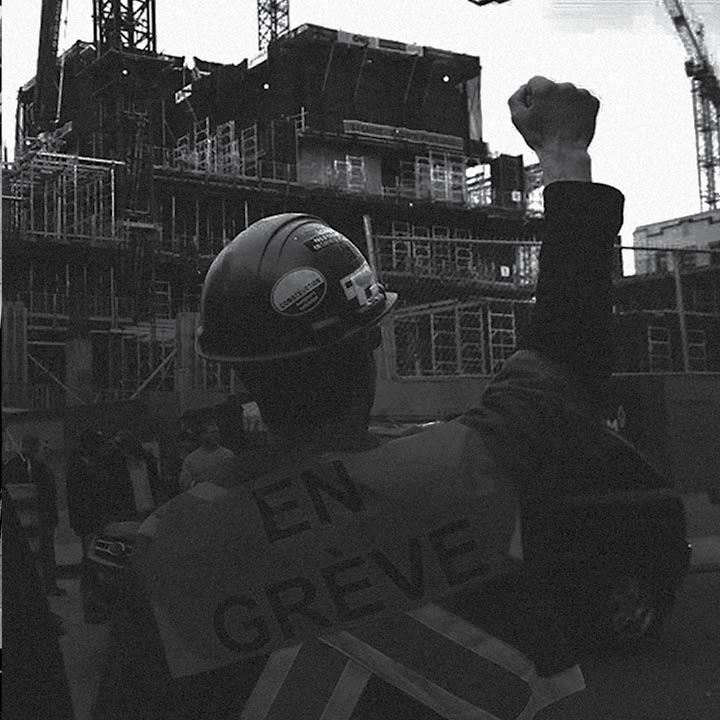
 (New) Communist Party of Canada / (Nouveau) Parti Communiste du Canada