
Produced Early 2024, Published February 2025
- The (N)CPC’s necessary rupture with Third Worldism
- The OCR’s conception of class
- How does Lenin see the “split in socialism”?
- Class analysis: theoretical abstraction or concrete analysis of concrete conditions?
- The (N)CPC’s Vision of Socialism
- Loose Ends and Concluding Remarks
To the comrades of the OCR,
As proletarian internationalists who have assumed the duty of walking the long and arduous road toward the overthrow of our respective imperialist powers by proletarian revolution, it follows as a matter of principle that we are duty-bound to make a critical scrutiny of one another’s political lines to ensure that we are mutually working toward that objective. After all, we can agree that the political future of the proletarian classes of our respective countries is greatly intertwined in the common overthrow of the whole Anglo-American Imperialist Alliance.
In that spirit, we have received your congratulatory note and critical remarks on the new Political Program of the (New) Communist Party of Canada with a welcome and high regard. Notwithstanding our pre-existing level of political unity concerning the necessity of building and fighting for the dictatorship of the proletariat in our respective countries, your critical reading of the Political Program raises some questions that must be answered, and in so doing opens up an important exchange between us and for communist revolutionaries across North America in general—the question of revolutionary strategy in our respective imperialist countries.
Your criticisms of our Political Program have brought to the surface some of the strategic and theoretical points of difference between our organizations at this point in time. As we enter into this public exchange, let us just say in advance that we seek to avoid both dogmatic sectarianism and a keep-the-peace liberalism—too often, those who’ve come before us have erred in one of these directions or the other. We consider you to be serious communist revolutionaries, fraternal comrades in the international communist movement (ICM), and, more importantly, we share a geopolitical reality that the proletarian classes of our respective countries will likely have to conquer together in some intertwined way for socialism. So, the (N)CPC salutes your efforts, accomplishments and progress to date, and we commit to carry on along side you, in unity and struggle, as well as with all other genuinely revolutionary communists and communist parties in the world.
From the top, we’ll concede that, concerning among some of the theoretical and political points you’ve raised, certain of these things we have yet to develop a formal line or a deeper theoretical elaboration around that we’re prepared to bring forward publicly, such as around the labour aristocracy and the women’s question. But these concessions are minor and secondary to what is principal in our reply, which is that we have some major disagreements with a number of the overall criticisms from the OCR and thus believe it necessary to respond publicly to these. In any case, your statement turns out to be a welcome medium to address what are ultimately fundamental questions for communist revolutionaries in the imperialist countries.
Our response, in turn, raises some questions we have about your conception of revolutionary strategy as well. Some of these questions will serve to counter some of the criticisms you’ve laid out in your statement. And many of our questions may only be able to be answered through expanded practice and further investigation.
The main strategic difference that this exchange has surfaced between our organizations (at this point in time, at least) is how we conceive of the role of the “lower and deeper” sections of the proletariat in the proletarian revolution of an imperialist country. At least since the time of Lenin and the emergence of modern capitalist-imperialism, this has been a matter of great strategic significance for communist revolutionaries in the imperialist countries. The position of workers’ centrality in our Political Program might lead you and others to jump to the conclusion that we have radically different views of the role of the lower and deeper sections of the proletariat—and perhaps we do in some ways. But in our view, we’d strike closer to the essence of things to say that perhaps we have different conceptions of what it’s going to take to make a socialist revolution in the imperialist countries and to bring the dictatorship of the proletariat into power. We assert that we need the working class broadly, especially the industrial proletariat at the heart of it, and not only the most oppressed sections of the proletariat, whose struggles we must, of course, build into the proletarian revolutionary struggle in whatever ways are dictated by a sound revolutionary strategy.
Is this a tactical difference between us reflecting the distinct tactical imperatives of organizations at different moments in their development or facing distinct challenges in their own countries and party-building projects, or is this a strategic difference between us that reflects distinctions at the level of class analysis? We will do our best to answer this question in a concrete, scientific and revolutionary way, with all due consideration for the fact that we are of two very different countries (even if, in some other ways, they are very similar countries) and that to be concrete here means to have a comprehensive class analyses of our respective countries—analyses that, as far as we can tell, we both have some ways to go to more fully account for.
Of utmost concern to each of our organizations is how to conquer the dictatorship of the proletariat and socialism in our respective countries—this is what differentiates us from the revisionists, the social democrats, and the rest of the Left. Among the immediate questions that arise from this shared pursuit of ours are: What is the class analysis of our respective social formations, and what is the alliance of classes capable of truly defeating the bourgeoisie? Surely we must have a correct and up-to-date conception of class forces and objective conditions to prevail in the revolutionary struggle in our countries. Struggling for and arriving at these political truths has been the content of our shared theoretical collaboration so far, which we have cherished to date and look forward to advancing much further, in unity and struggle.
Correct us if we are wrong in our impressions, but according to the understanding we’ve arrived at about the OCR’s political line, based on your published writings and our exchanges, the OCR is arguing for the construction of a communist party along and across the lower and deeper sections of the proletariat. Why? In some previous exchanges, you’ve raised that “this section of the proletariat brings the strategic strength of a “nothing to lose” spirit and material reality and has been responsible for many of the sharpest class struggles in imperialist countries, especially urban rebellions,” which we can readily agree with. But while this may be true, you have yet to account for how this leads to the overthrow of the imperialist bourgeoisie. We don’t expect you to have an answer for that quite yet—after all, the Bolsheviks didn’t know precisely how they would overthrow the Tsarist state until 1917; what they did know is that it would require a revolutionary civil war, as you likewise recognize, as do we and as did all of our predecessor organizations. However, at this point in time, we are compelled by our proletarian internationalist duty, just as you were compelled to share your belief that we had departed from Lenin, to remark upon what we see as a shortcoming in your strategic conception thus far.
To be clear, the (N)CPC is not arguing against work across the lower and deeper sections of the proletariat. Many comrades of the Third Party-Building Movement in Canada between the 2000s and 2010s come out of struggles that prioritized proletarian struggles outside the workplace and among the lower and deeper sections of the masses. The work of communist revolutionaries from the recent past in Canada among the lower and deeper sections of the proletariat amounts to experience that we still have much more to say about or learn from. We look forward to further summations concerning the history of those struggles, just as kites has done by bringing forward a summation like “From the Masses, To the Masses: A Summation of the October 22 Coalition’s Resistance to Police Brutality in the Late 1990s” (in kites #1). So, this is a matter of real-time debate and continued practice and experimentation in our organization, and there’s still further social investigation and class analysis to be done. We are not underestimating the rebelliousness or indignation that can be aroused among those sections of the proletariat who are living on the razor’s edge of the bourgeoisie’s dispossessing force (imperialist war and plunder, mass layoffs, evictions), and we are not suggesting that those sections of the proletariat will not play an important role in the revolution. What we are saying, however, is that a socialist revolution cannot be made without the working class, especially (but not only) the industrial proletariat, and that we must come to appreciate things in their correct proportions.
Many of us in our Party have read your contribution in kites #8 and have glowed with pride at learning more about the past century of militant, proletarian revolutionary traditions in the US, as well as appreciated getting to know your critical summation of that history. These are historical experiences that vindicate our shared Leninist outlook that the epoch of imperialism is also the epoch of proletarian revolution and that communism springs from the pores of bourgeois society. In our country, we also seek to recover and build upon the legacy of the previous revolutionary militant labour traditions of Canada—the 1920s–30s and the 1960s–early ’80s—and one of the ways we plan on doing this is by forging a new generation of working-class militancy under revolutionary influence and direction. It’s been over forty years since the labour force and unions were a battleground for communist revolutionaries, and we’re not going to wait another quarter century before we start organizing in what we believe to be a most decisive section of the proletariat. In the absence of a communist vanguard party that is able to contest the opportunism of the labour aristocracy, it’s no wonder that working-class consciousness is where it is today. We are aware of economist deviations of the past, and continue to study those experiences so as to not fall into those same pitfalls. However, based on a fair bit of social investigation and class analysis (SICA), theoretical work and political practice to date in our Party (all of which is ongoing, to be sure), we can see that the contradiction between the bourgeoisie and labour has been sharpening for many years now and is at such a level to warrant that we Communists take very seriously the accumulation of revolutionary forces in the labour force.
Let us make reference to one of the strategic innovations in Mao’s revolutionary class analysis of China in order to advance the argument we’re trying to make. The linchpin of Mao’s strategic conception of protracted people’s war (as applied to China in that period) was a correct conception of the strategic distinction between the leading versus main classes required to resolve the principal contradiction of the then semi-feudal, semi-colonial China. Mao’s answer to the contradictions of Chinese society was the new democratic revolution. In his class analysis, Mao assigned the proletariat the place of the leading role even though it was a very small minority of the popular classes in China at the time. Despite the main class of the 1949 Chinese revolution being the peasantry (the numerical majority), the leading class ideologically speaking and in terms of the future of China was the proletariat. As Mao said: “Though not very numerous, the industrial proletariat represents China’s new productive forces, is the most progressive class in modern China and has become the leading force in the revolutionary movement.”1 As we know, Mao then further subdivided these classes by further distinguishing their relations to production and, by extension, to the revolution. For example, being clear about the differences between and among landless peasants, small peasants, and rich peasants was a conceptual pre-requisite for being able to correctly lead the masses through the agrarian revolution, which was an integral part of the people’s war, and mobilizing them for the historical task of socialist revolution ahead.2
Now, we in the (N)CPC haven’t made any explicit arguments about leading vs. main forces as of yet—that requires further investigation and practice on our part. But we do believe that comrades in our Party have made sufficient investigation into the conditions of the working class in Canada—not to mention our studies of Marxism-Leninism-Maoism—to warrant the position that workers will have to play a central role in the socialist revolution in Canada, and that there can be no socialist revolution without them. This is why we stand by the position of workers’ centrality in our Political Program.
Now, had we taken the position of workers’ centrality with no substantial elaboration on the national question in Canada, a country with a significant colonial contradiction at the core of its existence, then that would warrant scrutiny and maybe criticism. But we did not do that. To the contrary, with the publication of the Political Program of the (N)CPC, we believe that we have laid down positions and resolutions on the national question that not only exceed the empty sloganeering and idealist formulations of Leftists but also anything that we have yet come across in the preceding communist party-building movements in our country. We believe that our position on the multinational socialist confederacy acknowledges and confronts the national questions and class character of Canada as it is today and responds to that reality with the only possible path to the dictatorship of the proletariat that we can see. Though we’ve not assigned “leading” and “main” strategic designations to our class analysis (at least not yet), we are very clear about the strategic fact that the industrial proletariat exists and that it is the key to critical sectors of production, circulation and infrastructure that will be necessary to establish and defend the socialist revolution. Are we saying that these sections of the proletariat in their present state are readily and spontaneously the most revolutionary among masses? No, we are not. To suggest that would be a blatant disregard for how the institutions of class peace and counter-revolution work in our, and many other, imperialist countries. We’ll readily admit that the proletariat in Canada is stratified and that its upper strata can be more conservative. But we must ask: to what extent does that conservatism reflect the decades of complete absence of communists from the working class? The SICA that our comrades have been carrying out in the working class and popular masses in the past few years reveals a very real sharpening of contradictions between workers and capital (or the state) everywhere we look. Frankly, our Party is trying to keep up with the pace of the struggles unfolding around us, which speaks to the fact that mass resistance and workers’ resistance is an objective fact that exists, at least to a certain extent, independent of us communists. It’s clear to us, therefore, that the labour force is already ripe for revolutionary intervention: class struggles are already breaking out across them, in both union and non-union settings, and too often workers are left feeling frustrated or betrayed by union bureaucrats. This objectively existing resistance is ripe for revolutionary intervention; but left alone, or rather, left to the omnipresence of bourgeois ideology, it will only become cynicism and despair, becoming rot for reaction instead. These are the conditions that we’re seeing in the working class, which we believe must be seized upon to create footings for the revolutionary option in the labour force in the years to come.
The (N)CPC is moving beyond the Third Party-Building Movement’s limitation of having no presence within, or even disavowing, political work among workers and in unions. For all these aforementioned reasons, we can no longer defer the return of revolutionary communists to the working class in Canada where they work. We are not saying this to the exclusion of the role, contribution and stakes of other segments of the proletariat in the proletarian revolution—that would be a deviation. But we are still working out precisely what this means with respect to our social formation, and we suspect you are as well. We also know that our countries are distinct social formations with their own distinct national questions and contradictions which will come to bear on our respective proletarian revolutions in necessarily distinct ways. These distinctions are both necessary to apprehend and very fascinating to understand. This is what has made many comrades in our Party keen readers of what US-based comrades and contributors have been writing in kites concerning the national question, the upsurges of the lower and deeper masses and other conjunctural analyses. We’ve followed your social investigation closely, have rated it for its exemplary character, and we look forward to even more of it. However, we remain wondering how the OCR conceives of the broader working class in the US in the proletarian revolution.
It should be said that the distinctions between our strategic conceptions may reflect, to some extent, a partiality of view of one or another’s (or both of our) investigation(s) into our respective social formations at the present time. But to the extent that these differences between our strategic conceptions reflect deeper differences around questions of class analysis and revolutionary strategy, we owe it to each other, as fraternal organizations, to elaborate upon and expose what may account for these differences, as these are strategic matters of significance for communist revolutionaries the world over, especially those of us in the imperialist countries.
Some of the major differences in class analysis that the OCR points to in its “Red Salute” statement concern: how we analyze the labour aristocracy, where we draw the line between the petty bourgeoisie and the proletariat and what is to be done with the industrial proletariat, and labour broadly, in the proletarian revolution. Please grant us some space to comprehensively argue our class position, such as it exists at the present time, for you comrades and for kites readers in general. Some parts of the research, investigation and theoretical work that we conducted to ground the analyses and positions in our Political Program are still forthcoming and planned for future publication, and we look forward to sharing these when they are prepared for publication. In the meantime, there’s already much that can be said.
The (N)CPC’s necessary rupture with Third Worldism
One of the ideological breaks that our Party has made with the Third Party-Building Movement (and much of the rest of the MLM currents across North America throughout the 2000s and 2010s) is with that kind of Third Worldism(-in-effect) position, whereby whole sections of the working class were written off as “bought off,” “corrupted,” and to be counted as part of the labour aristocracy or as part of the “bourgeoisified” strata of the working class that has supposedly been or is being corrupted by imperialism. This ideological trend became widespread online throughout the 2010s, conveniently relieving a lot of Leftists in the US and Canada of the burden of trying to figure out how to make revolution in their own countries (which merits, as far as we’re concerned, filing this whole trend into the category of preventive counter-revolution at the ideological level). As for our two predecessor organizations in the Third Party-Building Movement, they did not carry the worst expressions of that ideological trend, but they did sometimes give them too much space and also did not definitively rise above them. One of the expressions of that shortcoming was a disavowal, or at least an avoidance, of struggling on the terrain of labour.
As we’ve already said, we’re making a break from that deviation. Our SICA and theoretical investigation reveal that the conditions of the working class on the whole are deteriorating and have been in a protracted way for decades now. Add to this overall secular decline the fact that recent decades have also been frequently punctuated by major offensives of the imperialist bourgeoisie and finance capital against the working class—which we can admit can be as destabilizing and rebellion-inducing as Kenny Lake’s Spectre series and other writings have argued concerning the “motions of capital”—and we are led to the conclusion that communist revolutionaries cannot merely look to the lowest and most oppressed alone for the success of the proletarian revolution. We wholly endorse the presence of communists among these masses in times of such upsurge, in accumulating revolutionary forces through such political convulsions and in elevating and organizing those sections of the proletariat and popular classes that we can during those periods and through their struggles. But this alone is insufficient to make a proletarian revolution. We recognize that you do say that “with our feet firmly planted among those masses, we can and should carry out political work among all other sections of the popular classes,” but we are concerned that your class analysis of the remainder of the popular classes may inhibit the necessary political work from being undertaken to build the revolutionary united front that can create the conditions of possibility for the proletarian revolution.
Let’s advance our argument by getting to the question of our respective views on Lenin’s theory of the labour aristocracy. OCR criticizes the class analysis of the (N)CPC as resting on faulty theoretical foundations because we do not take into account the “split in the working class” caused by the development of capitalism into imperialism, as theorized by Lenin. It is true that there is no explicit mention of the labour aristocracy within our Political Program,
and that we don’t treat the question of opportunism in the labour movement explicitly in that document. But is it an absolute error to not foreground this question? We do mention “the combination of labour-management partnerships, restrictive labour laws, and a general acceptance of those restrictions by union leadership” when speaking about the present weaknesses of the proletariat. But frankly, the question of labour strategy is still being debated (and experimented with) in our Party, and if we didn’t speak more to the question in our Political Program it’s because we weren’t interested in doing so at this juncture and in that document—we’ve simply chosen to emphasize or foreground other questions for the time being. You and other readers may find this question too lightly treated for your own liking, but it’s clear to us, based on our analysis of our concrete conditions, that becoming and ass-kissing to the labour aristocracy is not the historical deviation out of which we’ve pulled the remnants of the third party-building movement. To the contrary, the deviation we are working to overcome is one of avoiding labour struggles altogether. If your concern is that we may over-correct and deviate in the direction of opportunism, well, that would be erroneous on our part and that would certainly merit criticism. So, while perhaps a few things could have been sharpened up further in the program, a struggle around this question was not a principal concern of the (N)CPC leading into our Founding Congress in 2023. A number of other questions were prioritized to consolidate the revolutionary program that we now have, the results of which are in that program, and the question of the labour aristocracy was not one of them.
That is not to say that this and many other important questions do not remain to be debated (as we shall say more about below). But that didn’t and shouldn’t have stopped us from putting forward a revolutionary program that we believe still marks a significant step forward for the proletarian revolution in our country.
You OCR comrades are saying that “[you] are not making a moralistic argument” when you speak of the importance of the “lower and deeper, most exploited and oppressed” sections of the proletariat, but rather “a strategic one” that these sections of the proletariat “constitute the bedrock social base for revolution and proletarian internationalism owing to their life conditions” (our emphasis). But must we “base [our]selves on the lower and deeper”? Why, if not for moral reasons? Let us be clear about the strategic reasons. What exactly is the role of the lower and deeper in the revolution? If by “bedrock” you mean that revolutionaries can find fertile ground in those sections of the proletariat for rooting, experience and expansion, we can readily agree to that. We recognize that the most oppressed sections of the proletariat do indeed explode in rebellion from time to time, especially that of the oppressed nations and especially the youth among them, just as we recognize that the Party can accumulate forces therefrom (like the once-upon-a-time revolutionary RCP, USA seems to have managed to do with some success through the 1980s and ’90s, as kites #8 sums up). But unless we’re expecting that the lower and deeper sections of the proletariat to go it alone (which you may not be explicitly saying, but it seems implied) then we urgently need a theory and a method to crack the puzzle that is the revolutionary organization of the rest of the working class and the popular masses.
We understand why you comrades identify with the MLM tradition in the US that traces its historical development out of the Sixties through to the creation of the RCP, USA and past its break with those trends that, in your analysis, proved themselves to be more “workerist” and ultimately revisionist. Your summation in kites #8 accounts for how that trend that broke away from the RCP, USA in the late 1970s was downright wrong on the counter-revolutionary developments taking place in China in that period and would later continue on in a social-democratic and revisionist direction in subsequent years.3 By contrast, you recount how the RCP, USA “[went] out broadly in society with revolutionary politics and to grow, organizationally, on a correct ideological and political basis.” Certainly, the RCP, USA’s newspaper seemed like an impressive operation that aimed to do just that. (In fact, the RCP, USA’s former propaganda work is something that some of our comrades over at the Media Staff of our Party have looked into.4) But did it turn out to be correct for the RCP, USA to leave labour to the side entirely for the rest of its existence, leaving that terrain to be entirely dominated by revisionists, Trotskyites and social democrats or “democratic socialists”? Perhaps that was a correct decision in the 1980s, but whatever we make of those past strategic decisions, is it correct for our generation of communist revolutionaries—decades later and amid crises both acute and chronic gripping bourgeois society and the working class—to continue on in that tradition of forfeiting labour from our fields of struggle?
The Italian Maoist comrades of the (n)PCI and the CARC have made it a point of debate for the whole ICM that we understand well and comprehensively the nature of the economic crises playing out.5 However we conceive of the precise nature of capitalist crisis, its laws of motion and tendencies, we can probably all readily agree that through the 1970s-80s, the decades that the academics refer to as the beginning of “neoliberalism,” the bourgeois offensive against the proletariat was certainly ramping up once again. The distinction that we communists bring to the analysis of that turning point in history is to also recognize that whatever our analyses of capitalist crisis, that shift occurred in the midst of and in response to the triumph of revisionism in the international communist movement (ICM) with the consolidation of counter-revolution in China, which amounted to a dramatic disarming of the international proletariat and tremendous defeats and setbacks for the masses of humanity.
In our country, this great and tragic reversal in the ICM took the form of the liquidation of two significant communist vanguard parties and organizations that survived and existed up until the early 1980s, namely the Workers Communist Party (WCP) and In Struggle!, which were rival Marxist-Leninist formations that had somewhere between many hundreds to well over a thousand members each. Both of these organizations were bilingual and had presence across many parts of Canada, but each was heavily concentrated in the province of Quebec. The WCP in particular had a strong base in the working class at and around sites of production and, where and when necessary, in the bourgeois “labour movement.” Despite an impressive run coming out of the 1970s, these two parties completely unraveled in the early 1980s under the weight of a number of questions that they did not seem prepared to answer, most especially but not only the national question in Quebec and how the regime of preventive counter-revolution in Canada was conforming itself to the challenge posed to it by two decades of rising nationalist and class militancy in Quebec. The outcome would be one of Canada’s most social-democratic provinces, the triumph of bourgeois nationalism in Quebec, and its reintegration into the Anglo-American Imperialist Alliance on new terms.6 The liquidation of the revolutionary Marxist-Leninist movement in Quebec constituted the second great retreat of revolutionary communists from the labour force in Canada.7 The early 1980s, therefore, saw the triumph of revisionism, capitulationism, and social democracy in the working class in Canada—and these have, ever since, remained the dominant trends in the bourgeois “labour movement.” It’s really a tragedy that some section of the Second Party-Building Movement in Canada couldn’t hold itself together to sync up with developments in the coming years that would lead to the consolidation of the Revolutionary Internationalist Movement (RIM), which could have perhaps propped up and re-inspired a new generation of communists in Canada to pick up the torch of proletarian revolution much sooner.8
One of the weaknesses that we’ve found so far in our still limited investigation into the second party-building movement is that parties like the WCP and In Struggle! may have prioritized their polemics with one another more than actually forging a clear strategy for proletarian revolution in imperialist Canada. But what we will say about that whole era, especially the work of the WCP, from what we know so far, is that a serious Marxist-Leninist force was accumulating strength in the working class. This is an experience that should be known and studied more, not because we think it was perfect and exemplary in all ways, but because we need to learn from the most successful examples of communist revolutionary attempts that have come before us. As far as we understand it, the WCP alone had upwards of a thousand cadre, largely concentrated in Quebec, but also spread throughout the rest of the country as well, with a significant part of its work focused on industrial agitation and building class struggle in the labour force. Astonishingly, the WCP was liquidated almost overnight and in a “fire-sale” kind of way, with a clear triumph of opportunism in the wake of that party’s demise. We have yet to fully wrap our heads around that break-neck turn of events, and indeed many a former comrade of that Party have shared stories of their devastation and bewilderment at the rapid unraveling of their Party and the revolutionary movement it was advancing. We look forward to sharing with you and kites readers two pieces of summation that treat the WCP experience that are coming forward very soon in kites #9.9
We raise this context to highlight that since the 1970s we can count at least one place on this continent where class militancy and communist intervention in the working class went together in a powerful way for a period of time. What accounts for the absence of communists in the labour force ever since has been the complete lack of a communist vanguard (throughout the 1980s and ’90s) or the unwillingness of anything aspiring to become such a force to take on that field of struggle (the 2000s and 2010s).
Now, you comrades write in “Red Salute” that “coming from a Leninist analysis of imperialism and the split in the working class, we disagree with the principle of ‘workers’ centrality’,” continuing that “[i]t is worth noting that this was the operational principle guiding most, if not all, of the “ML” (in the Maoist sense) movement in the imperialist countries in the 1970s, and following that principle led those organizations down the path of economism, reformism, and revisionism.”10
Along the same lines, in kites #8, you also critique and define “workerism” as (our emphases) “being narrowly fixated on workers in specific (large-scale) industries, and the related trend of economism mean[ing] focusing on the narrow economic interests and immediate concerns of the workers rather than the larger political struggle to overthrow the capitalist system and build a socialist society.”
Indeed, we could maybe agree with this definition if “narrowly fixated” is what characterizes the overall work of a given communist organization.11 But narrowly fixated we are not. Nor are we interested in the narrow economic interests of this or that group of workers only. There’s a good reason why this tendency characterizes many Trotskyist and revisionist groups: their aim is not revolution, or even real class struggle in the labour force, but rather, as countless examples can be given to illustrate, permanent implantation in the labour aristocracy and class peace with the bourgeoisie. Contrary to this, we’re interested in entirely overturning this class peace, whether or not that means we need to go through existing unions to make that happen and despite the fact that many corrupt and lazy bureaucrats may try to stand in our way (the real labour aristocracy, which we’ll get to further below). For a time, as we understand it, overturning this class peace within the “labour movement” is precisely what the WCP was trying to, and indeed was, doing for some time—until opportunism got the best of it and liquidated it. But alas, revolution comes with all sorts of risks and deviations—that doesn’t mean that we should condemn the attempt.
We’re saying that we need the industrial proletariat to make revolution, comrades. Surely you’re not arguing that the lower and deeper can go it alone in making revolution in the US, are you? For instance, if there were enough revolutionary communists at the head of the 2020 summer of rebellion against police brutality, that revolution could have been made through a series of twists and turns in the popular rebellion? We think not, and likely neither do you. Maybe your disposition is more tactical and you look to these experiences as opportunities to accumulate forces and create many schools of communism for the politically advanced masses? That would be excellent. But at some point you have to confront the question of how to actually overthrow the imperialist bourgeoisie, which we know well you comrades have no spontaneist illusions about. As the OCR Manifesto states (second emphasis ours), “overthrow[ing] the rule of the imperialist bourgeoisie…can only be done through a revolutionary civil war that destroys the repressive state apparatus and political institutions of the bourgeoisie and seizes the means of production.” Given this position, the question remains to be answered: How will the industrial base for the revolution be conquered? Precisely because of the conservatism that you comrades identify among certain strata or sections of the working class, we cannot expect such sections of the proletariat to spontaneously align themselves with the proletarian revolution. To the contrary, we must be seeding and cultivating the industrial proletariat once again in a revolutionary direction because we have many years of work ahead of us to make this decisive section of the proletariat (in our view) an actual revolutionary force. This is why we reject the criticism that this orientation of ours is an economistic one.
You have also written in kites #8, that “the RCP’s 1981 Program still gives considerable emphasis to the industrial proletariat” even though “its instincts led it to the lower and deeper sections of the proletariat,” but that the problem was that it “did not fully elaborate, in theory and analysis, why the (more stably employed) industrial proletariat was not the main social base for revolution in the US.” Going back to the reference above to Mao’s class analysis of China and the difference between main and leading forces, perhaps the industrial proletariat was not, or is not, the main base for revolution in the US. But does that rule out that it may be the leading force, or at least a part of that force, to which we must look to organize to win to the proletarian revolution? We can’t answer this question with respect to your social formation: it’s your task to answer these questions and we look forward to further class analysis from you comrades. But with respect to Canada we are clear that the revolutionary communist vanguard party needs to become the brains, nervous system and beating heart of the working class once again.
A political line that completely ignores the working class, its productive role in society and its necessity for socialism is antithetical to our overall tradition, to Lenin, and to what was defended by the Red International of Labour Unions (Profintern) and the Comintern. Any such political line also pushes in the opposite direction of some of the most successful periods in the history of communism in Canada, in the US, and across the imperialist countries. Such a view is certainly in contradiction with the (N)CPC’s orientation to labour.
The (N)CPC considers interventions in the labour force—including but not limited to “organized labour” and unions—to be of strategic importance for the overthrow of the bourgeoisie (through general and/or strategic political strikes, but not only those12) and for the construction of socialism (through proletarian control over the means of production). We are not saying that the industrial proletariat is sufficient for the making of proletarian revolution, but it is necessary. Without a solid base in natural resources, manufacturing, food production, education and healthcare, our communist party and the dictatorship of the proletariat will not succeed. An attempt at revolution without these key sections of the proletariat firmly on board would be suicidal because the proletarian revolution would completely lock itself out of segments of the popular classes and the working class that it will be unable to later swing over to, or have organized in support of, the revolution. Any communist strategy that expects such crucial elements of the proletarian revolution to just fall into place at some undetermined future time would be spontaneist and idealist, which is why our Political Program has given emphasis to workers’ centrality now.
If the communist revolutionaries had played a much greater role in the summer of 2020 rebellion against the police and other symbols and institutions of the dictatorship of the bourgeoisie, we doubt that this would have done anything but make for stronger protests, maybe more sustained protests, with a better class line and maybe some more militant confrontations. But this movement would have still had to face an armed apparatus that would have still vastly out-powered and outgunned the popular movement, and with no likely spontaneous solidarity from the rest of the working class—and it’s this latter point, the likely absence of the rest of the working class, that is of concern to us. Sure, it’s possible that that kind of intervention could propel to a national stage an embryonic revolutionary movement, but if we’re making our play from the mountains of Ayacucho to the roadside shantytowns to the slums surrounding the capital, then we had better make sure we have a correct analysis of the forces and conditions to actually win that people’s war once we get it going.13 The point is: we require communists to be present in the labour force, not to the exclusion of all other sections of the proletariat, but alongside them, forging their interests in a common political direction. The (N)CPC asserts that the proletariat must seize the means of production, and only with the proletariat organized within and across these means of production can we make such a proletarian revolution.
We can understand why the OCR may tactically direct its focus toward the lower and deeper and most oppressed, which may be based on a sober assessment of current forces and where the greatest gains can be made under present conditions. It stands to reason why this sort of political work is a strong point of origin for a future communist vanguard party and a key place from which to begin building out a larger class analysis of the social formation of the US, a revolutionary program for the proletariat to overthrow it, and an overall revolutionary people. However, in the mean time, we must ask: Is the OCR elevating this category of “life conditions” above and beyond the Marxist category of one’s relationship to the relations of production?
The (N)CPC opposes economism but upholds that the Party should intervene in all sectors of the proletariat (and in all sectors of society, for that matter). We understand that some sectors of the proletariat, despite not holding a strategic place in production, may be more oppressed or oppressed in distinct ways, that some may be more subjectively open to revolutionary ideas and organization, and some may be experiencing crises of a conjunctural or sectoral nature. The tactical intervention into these proletarian struggles may be very significant for the accumulation of revolutionary forces today. But to confuse tactical priority with strategic priority, and to say that the Party doesn’t need to strategically build itself to the point of being able to control the means of production seems to us a mistake.
Not only does the (N)CPC not reject the Leninist line of targeting the “most oppressed and exploited,” in addition to what we’ve said about the lower and deeper versus the industrial proletariat so far, we must also say that this orientation toward the lower and deeper also concerns our work in the industrial proletariat as well. In Canada, this is evidenced by: the overrepresentation of temporary foreign workers in agriculture and food processing and production; the overrepresentation of women, especially from the oppressed countries, in the lowest echelons of the health care system; the high number of asylum seekers in placement agencies doing factory and warehouse work; the high number of Native people in heavy industry; etc.14
Is it the case that in the US somehow the “industrial proletariat” and “most oppressed and exploited” form entirely distinct groups of people? We see from Part IV of the Spectre series that you give some consideration to these sections of the labour force, but again this seems to be more driven by organizing the more oppressed than organizing the strategically necessary. In any case, we look forward to a fuller class analysis from you comrades on these questions. It is not for us to dictate the strategy and tactics of communists in another social formation. We can only comment from a distance and point out what we are critical of.
In summary, we believe that the (N)CPC has made a crucial break from a kind of Third Worldism that held back the development of the Third Party-Building Movement in its search for a revolutionary strategy. As we say in the final words of our Political Program, “We are the party of the Communards of Paris, of the Bolsheviks of Russia, of the Chinese Revolution and of the heroic anti-imperialist resistance in Vietnam… of the Winnipeg General Strike, of the revolutionary days of the old Communist Party of Canada, of the Front de Libération du Québec and of the 1970s Marxist-Leninists.”
The OCR’s conception of class
Let us dig further into our respective conceptions of class. We refer to the OCR Manifesto for the OCR’s conception of the proletariat: “The proletariat consists of those who have been dispossessed of any means to make wealth except for their own labour, who labour in conditions of exploitation, who can only find work if and when they are needed by the capitalist class, and who work collectively, on a world scale, within socialized rather than individualized processes of production.”
On the surface, this definition largely corresponds with the (N)CPC’s definition in its Political Program. But let us press on a part where the difference can be surfaced. The OCR definition states that the proletariat consists of those “who labour in conditions of exploitation,” leading us to ask: isn’t labour that is accomplished by someone who is dispossessed by definition exploitation? Or is there more to what constitutes exploitation? Perhaps this is linked to the OCR’s vision of the labour aristocracy (which we will get to further below).
This passage from the OCR Manifesto continues with its analysis of the proletariat: “In the US, the proletariat includes the immigrants exploited in the fields, food production facilities, and service jobs; the “surplus populations” whom the capitalist class has no productive use for and so are locked in prisons, confined to ghettos, and have no choice but to work in the illegal economy to survive.” Certainly these are all sections of the proletariat. Who else, though? You continue: “and millions of others slaving away in low-wage factory work, the service and food industries, transportation, shipping, and other economic sectors of harsh exploitation.”
We must ask: at what income level does one cease to be “low-waged” and thus cease to be proletarian? For the OCR, are the workers who have claimed an average wage in factories no longer proletarian? Would the OCR say, for instance, that the auto workers who recently engaged in a major struggle in their sector, whatever the political character of their union and its leadership, are not part of the proletariat? At what rate does “harsh exploitation” stop being exploitation altogether? For instance, does a worker that makes $20/hr, and then negotiates a raise for $25/hr, all the while keeping the same job and very similar living conditions, cease to be proletarian? This is not very clear.
Moreover, why is there no mention of education and health care workers in the OCR Manifesto? The education and health care sectors are cited as sources of profit-making in the OCR Manifesto, but are these occupations not essential for the reproduction of the working class, even if the role they’re made to play is in one way or another at the service of the bourgeoisie and the bourgeois state? In Ontario in late 2022, for instance, a one-day wildcat strike by education workers—those who work alongside teachers, but are not themselves teachers—threw the entire province into disarray as the schools had to shut down completely for the day. That’s just one thin segment of the working class whose job action threw the entire province into chaos for a day.
Comrades, your conception of the proletariat and its revolutionary potential seems to be more rooted in degrees of dispossession and oppression than it has to do with class as being determined by relation to production. To be clear, we think kites thus far has made important and excellent investigations and analyses of processes of dispossession being experienced by the proletariat presently or in recent years or decades—and obviously, these historical processes factor into the objective and subjective situation of the proletariat across its various sections and strata. But are there not more ingredients needed to make a revolution than the rebellious energy we may find in these sections of the proletariat?
It’s not our place to say how the OCR should be tactically orienting itself to the crises unfolding in the US, or where it should be accumulating forces and how it needs to be advancing its party-building initiative. We will accept if the OCR deems itself not to be able to intervene at this point in time in the struggles of the labouring classes. But we must say that as long as communist revolutionaries abstain from becoming a force in the working class again, we must recognize that we leave the door entirely open to Trotskyism, “democratic socialism,” revisionism, syndicalism and social movementism, and tailing the Democratic Party as the dominant and uncontested trends in the working class movement. If this situation continues uncontested for another 10-20 years, it would most certainly speak to a critical failure of communist revolutionaries in the US.
We don’t know what the OCR’s program for revolution is, and we think we can safely assume that you don’t either (as of yet). We don’t assume the OCR Manifesto to be that program, but rather a necessary first ideological tool for the gathering of forces for a new communist vanguard party. We appreciate the necessary modesty with which the OCR has presented itself to revolutionaries and revolutionary-minded people around it, and the brutal honesty about how far it needs to go and what struggles are needed to get there. But we do raise the above concerns because of the potential deviation if your present political line is raised to the level of strategy.
We see the masses broadly, including the working class, struggling with austerity via inflation, industrial closures, and dangerous and increasingly exploitative conditions. We see communities and regions fighting toxic destruction and resource plunder under Canada’s colonial regime. There reigns a dangerous mix of heightening exploitation and proliferating oppressions that we fully believe we communists can seize upon for the proletariat’s revolutionary future. There has even just been a major general strike in Quebec as of late, the largest in Canada in a half century. We believe the conditions of labour in this country to be ripe for political contestation by communists—that is, if such efforts are directed by the correct line on labour. We think that communist revolutionaries can and must begin contesting the domination of the labour aristocracy over the working class, especially when we have a program for the proletariat and those cowards and opportunists do not. They are brokers of class peace in an era where the regime of class peace has long been under siege and, if it cannot yet be said to be falling apart, is definitely facing a crisis of legitimacy.
Let us now turn to Lenin’s views on the “split in socialism” and the labour aristocracy.
How does Lenin see the “split in socialism”?
You say that our program doesn’t take into account Lenin’s observations on imperialism and the split in socialism because of the lack of a mention of these concepts in our program, because of our class analysis and also because of our position on workers’ centrality. Let’s get into that now.
You’re correct that the question of divisions in the working class isn’t emphasized or addressed in our program, but we’re not sure it needed to be. As we’ve said already, the (N)CPC is trying to correct the error of the preceding party-building movement of avoiding labour struggles and unions, which it did in part through emphasizing the divisions within the working class. This doesn’t mean the (N)CPC doesn’t take into account the important observations made by Lenin regarding the split in socialism and the divisions within the working class. As one of our comrades has written in an internal document of our Party: “The labour aristocracy, as we understand it, is made up of union employees of varying station that live off the dues paid by workers. They are bought off by the interests of Capital and are rotting the labour movement with their opportunism and reactionary social-democratic ties… These types, whether successful proletarian strivers or petty-bourgeois marauders, are reactionaries that must be stemmed if not excised from unions and labour organizations.”
So, while we have not published a deeper elaboration on the question of the labour aristocracy as of yet, this is at least one view, if not a prevalent view, on the question in our Party, and one that the Central Committee, by virtue of this statement, stands behind for the time being pending further investigation, practical work and theoretical elaboration. At the level of abstraction, however, we do believe this position to be in line with Lenin’s view of the labour aristocracy. The OCR also believes itself to be in continuity with Lenin’s analysis, but we have to question this when what we find in Part I of the Spectre series is a conception of the labour aristocracy that is much wider in its social basis than we or Lenin seem to hold (our bold emphases):
The fact is, many of those working in the most socialized labour processes with the most advanced productive forces have, over the last century or more, increasingly become part of what Lenin identified as the labour aristocracy. These are workers in the imperialist countries who receive super-wages (that is, wages whose value exceeds the value these workers produced) based on the super-profits extracted from the oppressed nations through super-exploitation (paying wage-workers below subsistence level) as well as theft of resources. This labour aristocracy, as a numerically significant segment of the population, holds stable, often salaried jobs with retirement and health benefits, often owns their own homes, cars, and numerous trinkets afforded by the parasitism of imperialism, and, consequently, far from being or acting like a dispossessed, exploited class, it has been an enthusiastic junior-partner of the bourgeoisie, including in its support for imperialist wars of aggression. As a class, it is a stunning refutation of the notion that working on advanced productive forces in highly socialized labour processes results in revolutionary class-consciousness.
For starters, we think there is confusion here between segments of the working class under the sway of the labour aristocracy and the labour aristocracy itself. The idea of a labour aristocracy representing “a numerically significant segment of the population” is a marginal view in the international communist movement (at least for those who aren’t Third Worldists) and a departure from Lenin’s conception. Is this a truth of the US social formation that defies the historical record? Has the long-running hegemonic status of US imperialism corrupted the working class to such an extent? We look forward to deeper investigation of these questions, comrades. But as for Lenin, this was not exactly his position.
Lenin analyzed the material basis for the split in socialism as being rooted in imperialism, yes, but leading to a political split in the working class, a split between what would become known as the Second and Third internationals, i.e., between “social-democrats” and communists, with the former constituting that section that was politically corrupted by imperialism. Indeed, according to Lenin, the superprofits due to the parasitism of imperialism allowed the bourgeoisie in the major imperialist countries to bribe a small upper echelon of the working class. But Lenin never spoke of this upper echelon as “a significant chunk of the population,” but as a small minority. He speaks first of workers bribed into political functions in the labour movement, and of workers of a handful of privileged sectors forming their social base of support in the working class. As Lenin writes in Imperialism and the Split in Socialism:
The bourgeoisie of an imperialist ‘Great’ Power can economically [Lenin’s emphasis] bribe the upper strata of ‘its’ workers by spending on this a hundred million or so francs a year, for its superprofits most likely amount to about a thousand million. And how this little sop is divided among the labour ministers, ‘labour representatives’ […] labour members of War Industries Committees, labour officials, workers belonging to the narrow craft unions, office employees, etc., etc., is a secondary question.
This upper strata, an absolute minority, forms the social basis from which the various “labour representatives” are bribed into opportunism. Lenin stressed communists must not aim their attention towards this minority, which dominates the labour movement and the bourgeois labour parties, but towards the majority, the real mass of workers who do not so much benefit from those bribes, even if they are imbued with its views and even if they represent a different stratum of the working class. What is decisive in the political composition and orientation of the working class is, in our view, the uncontested domination of opportunism in the working class, not the stratified differences within it, which are certainly material realities that we will have to contend with.
Lenin remarks on how Engels saw it as well: “[Engels] speaks of an ‘aristocracy among the working class… [of a] privileged minority of the workers,’ in contradiction to the ‘great mass of working people… A small, privileged, protected minority’ of the working class alone was ‘permanently benefited’ by the privileged position of England in 1848–68, whereas ‘the great bulk of them experienced at best but a temporary improvement.’”
The fact that the labour aristocracy constituted a small minority in contradiction with the majority, with “the great mass of working people,” is an essential point. That was then. What about now? The bourgeoisie has definitely not materially solved the contradiction between itself and the working class in the imperialist countries in any durable way. They merely bribe a small section on top and corrupt it politically by taking control and leadership of the labour movement. This is what we must change if a proletarian revolution is to succeed—there’s no way around it.
As far as we know, Lenin mostly spoke of the “split in socialism” and of the “split in the working class movement,” but not of a “split in the working class.” And we believe these words convey precise meanings that should not be lost to us. What we are up against is a political split. This leads us to the position that we must establish and hold combat positions in the labour movement, in unions and in the working class which offer more compelling political programs than Biden (or Trump!) 2024, or in our case, Trudeau (or Poilievre) 2025.
But OCR seems to take the position that the labour aristocracy forms a whole social class whose fundamental material interests are at odds with socialist revolution. To say the workers with comfortable jobs, better wages, mortgages, etc., benefit somewhat from imperialism and thus tend to have less revolutionary zeal and be politically influenced by opportunism is one thing. To say that they are “enthusiastic junior-partners of the bourgeoisie” and objectively rule them out of the category of “proletariat” is another thing entirely, and it is to confuse their present conservatism and decades of uncontested exposure to reaction as a permanent condition of their class position.
That a stratum of the working class is tied up with mortgages and may eventually come to own their own homes does not phase us. We would encourage, and indeed we ourselves are applying, a concrete analysis of the concrete conditions of homeowners. There was a tendency within the Third Party-Building Movement to consider home-ownership as signalling some kind of exit from the working class. But our research and investigation into the question has since revealed that more than half of “homeowners,” some 57% last time we checked (about a year ago), are indebted to the banks and are staring down many years if not decades of financial subjugation. Is it wise to consider these masses of people—yes, many of whom are petty-bourgeois, but many are also not—to be cast aside as not being in contradiction with the imperialist bourgeoisie, particularly finance capital?
Certainly, US imperialism maintains a vast and corrupting influence over its working class (as does Canadian imperialism), with its vast ideological power, its (waning) imperialist super-power military status and its vast mass incarceration system, which together serve to corrupt a large chunk of the working class materially and ideologically. You make this point well in Spectre Part IV when you point out the some five million or so jobs that go into the “Corrections” and “Justice” systems in the US. This is why understanding the particularities of our respective social formations is so important. But we have yet to see the larger class analysis from you comrades that merits arguing that you can make revolution with the lower and deeper alone, which you’re not saying directly but you are saying it indirectly by forfeiting leadership in the struggles of the rest of the working class.
Our concern is that Lenin’s and your analyses lead to fundamentally different practical conclusions. For Lenin, the conclusion is that the struggle against imperialism is intrinsically linked to the struggle against opportunism,
and thus that we have to expose the opportunists in the labour movement and bourgeois labour parties for defending the interests of a minority of privileged workers against the vast majority of workers who represent the true masses, the lower and deeper. Lenin makes the necessity of this political struggle in the labour movement very clear at the end of Imperialism and the Split in Socialism:
The only Marxist line in the world labour movement is to explain to the masses the inevitability and necessity of breaking with opportunism, to educate them for revolution by waging a relentless struggle against opportunism, to utilise the experience of the war to expose, not conceal, the utter vileness of national-liberal labour politics.
Contrary to this, the OCR seems to view the labour aristocracy in more economic terms, as a whole massive social class whose interests are materially at odds with socialism. The conclusion is thus that a great mass of workers, represented by those with stable, unionized jobs, are not part of the material basis for socialist revolution. The implication of this class analysis is, naturally, that we completely shun the labour movement and ignore this great mass of workers and their struggles in their workplaces, which in Canada constitutes some 11 million people.15
Whatever the terms of the class peace that has been stabilized for sections of the industrial proletariat in the imperialist countries, we must remember that these more stable, salaried jobs with benefits were achieved through some struggle and compromise in a context where workers had been fighting militantly and where communists were being pushed out of, or had retreated from, playing a revolutionary role therein. Please don’t confuse this as us saying that these imperialist-country workers have just simply earned their lot, while the rest of the workers of the world have not. What we are saying is that the proletariat in the imperialist countries struggled, for a time at least, and the response of the imperialist bourgeoisie, particularly after 1945, was to erect new pillars in the regime of preventive counter-revolution aimed at enforcing a more stable class peace in the labour force than had prevailed until that point in time.
As you shall see from the forthcoming interviews that our comrades from the Media Staff have done with some elder Communists who were once part of the WCP in Quebec (which we mentioned above already16), class militancy under the leadership of revolutionary communists played some significant role in Canada, particularly Quebec, through the 1970s and right up until the early 1980s. That the class conflicts of that era yielded a new stability is attributable not merely due to the passive effect of the super-profits of imperialism (real wages were actually growing during the time of Quebec’s tumultuous 1960s and ’70s), but because the bourgeoisie claimed the initiative and the proletarian revolution lost it. The revolutionary alternative was liquidated by opportunism, and what remained of communist revolutionaries could not regroup and rise to the occasion with a revolutionary response. In other words, what was decisive was the shift in the subjective factor, not the objective factor of real wages.
To the extent that higher wages were secured for some sections of the working class out of those struggles, we must account for the massive labour and popular struggles that were consciously organized by the proletarian movement through the 1960s and ’70s, two decades of struggle that included the whole nebula of progressive Quebec nationalist groups and movements, which took its highest organizational form with the Front de libération du Québec (FLQ) in armed struggle, the Rassemblement pour l’indépendance nationale (the RIN)17 in its legal struggles, the labour upsurge of the early 1970s leading to the Common Front general strike in 1972, and the rise of Marxist-Leninist organizations in the 1970s up through the early 1980s. These, taken together, form some basis for the gains of the working class through that period.18 Of course, we recognize that imperialist powers have more room to maneuver like this when it comes to addressing any feistiness of the working class in their own countries. But it would be as mechanical as it would be insulting to say that this historical outcome was the mere work of the objective forces of history alone.
More importantly, these gains began to stagnate in the 1970s, and then the struggle died out in the early 1980s. We have started the work of summing up that wave of party-building’s accomplishments and ultimate deviations and failure, but what we do know is that part of that defeat reflected the failure to struggle against opportunism. This failure led to, among other things, the loss of a revolutionary (or at least combative) political direction in the labour unions and their eventual integration into capitalism, which occurred through the founding of union-led capitalist investment funds and the eventual disintegration of Marxist-Leninist leadership in the working class with the wave of dissolution beginning in the early 1980s with the liquidations of In Struggle! and the WCP. This whole period amounts to the capture of a genuine proletarian revolutionary movement by the opportunists who held leadership positions in unions and popular movements. They were bribed into docility by the bourgeois-democratic Parti Québécois and the rising national bourgeoisie, the social basis of which was temporary gains given to some upper echelons of the working class and the petty bourgeoisie. If it’s our position that the imperialist bourgeoisie maintains and is constantly adjusting its regime of preventive counter-revolution and that labour peace is a pillar of that regime, then we would do well as our Italian comrades do to recognize that this pillar is the least stable one of all and has for decades now been disintegrating. So, let us work to topple it!19
So, Lenin’s analysis is 100% not that we should reject intervention in the labour movement and among those labourers with “stable jobs.” Yet, this is precisely what the previous two decades of Maoists in the imperialist countries have done. Contrary to this rejection, the stretch of Quebec history that we’ve just cited demonstrates the immense potential for the revolutionary movement in labour and the need for the revolutionary movement to lead relentless political struggle against opportunism.
We are not saying to you comrades that, tactically speaking, intervening in labour struggles now should be your urgent task. We cannot say this because we are not responsible for, and are obviously not as familiar as you are with, your conditions. We understand that you are still a young communist organization (as are we). We recognize the danger that submerging much of your still-nascent communist organization into labour struggles can potentially drag down still-green communist elements into syndicalism, social movementism, and even render them susceptible to the corrosive influences of those ideologies that are antithetical to proletarian revolution. But we’re not talking tactics. Our question for OCR is one of a strategic character: Do you not recognize the need for the industrial proletariat and the working class more broadly in making socialist revolution, even if this isn’t your principal work at this moment in time?
Comrades, our program is one that aims to overcome the previous limitations of the movement. It marks out key revolutionary tasks for the time being, with the principle of workers’ centrality guiding the unfolding of our revolutionary strategy. The actual split in socialism that we’ve been trying to overcome is the decades-long absence of the proletarian revolution from the labour force. We will not wait another 10-20 years to start rebuilding the Communist position in the labour force. We have taken this position not in a willful and idealist manner, but based on our provisional, though extensive, economic research and SICA work among the masses, not to mention practical activity in workers’ struggles. With that said, as we have written toward the end of our Political Program,
The (N)CPC does not remain dogmatically attached to the strategy and tactics outlined above, but submits them to [our] overarching goal and to the test of practice. As the sole criterion of truth, it is practice that will be the ultimate judge of the correctness of our ideas. The following years should either see the revolutionary movement advancing, or it should see our conceptions and practice change.
Class analysis: theoretical abstraction or concrete analysis of concrete conditions?
Now, setting aside our interpretations of Lenin’s texts, it is beyond our capacity to respond here to the point that the labour aristocracy constitutes “a numerically significant segment of the population” in the US and in the imperialist countries. We will leave you comrades in the US to form your own class analysis and revolutionary strategy based on your concrete conditions.
Let’s move on to your remarks regarding our class analysis of the petty bourgeoisie. You comment on our Program that:
We would not consider people in occupations that require college degrees and significant intellectual training and receive salaries based on that education and training, such as teachers and nurses, to be part of the proletariat, but part of the petty bourgeoisie, albeit sections of the petty bourgeoisie who we should strive to win over and who occupy important strategic positions in society.
There are certainly ideological and political aspects to consider when speaking of the role that formal education degrees plays in class consciousness and class mobility. Spending numerous years in the bourgeoisie’s ideological apparatuses will certainly influence someone’s class outlook, and there is certainly a correlation between a higher degree and a higher class position. But as to what defines one’s class position, a degree alone doesn’t cut it.
Social class is, as far as we understand it, comrades, defined as the place someone holds within the relations of production. This is how Marxists have always understood social class. We might not like the vibe of someone who has a degree or what a higher salary or wage may do to one’s mentality and outlook. What is decisive is where one is situated in the relations of production and how that relation is being affected and transformed by what our Italian comrades call the “developing revolutionary situation” over the last few decades amid the “second general crisis of capitalism.” When we add to the inherent tendencies of capitalism-imperialism towards economic crisis the additional crises stemming from the declining hegemony of the Anglo-American Imperialist Alliance to the up-and-coming imperialist contenders, who are claiming more and more market share of the global economy, we can begin to understand why conditions have been getting worse for the popular classes in the western imperialist countries. If it happens that whole sections of the working class are going over as “enthusiastic junior partners” of imperialism, do we communists not have some blame to take for that fact?
Coming back to the question of post-secondary education, whatever its ideological effect, what proportion of graduates are actually being catapulted into the petty bourgeoisie? Or is the question we should be asking: What proportion of students are, instead, becoming heavily-indebted for many years, decades even, just to get that degree, only to have a lot of those bigger earnings (by no means guaranteed any longer) clawed back by the state or finance capital? Was it not the (broken) promise of student debt cancellation for tens of millions of younger voters in the US that helped Joe Biden clinch the 2020 election?
It is also to be noted that although nurses and teachers are referenced once in the program when mention is made of the “shortage of skilled workers,” nowhere are they clearly identified as part of the proletariat. It is also to be noted that “salaried professional” positions are placed in the category of the petty bourgeoisie. Them being referenced as “skilled workers” doesn’t exclude them being part of the petty bourgeoisie, for even if they are, they are still “skilled” and they “work.” That said, there is a nuanced analysis to be made of professions such as teachers and nurses in Canada, and a unilateral position on this without taking account of the actual material reality of nurses and teachers, as well as the constantly changing objective circumstances and the class trajectory of those two occupations/professions, is likely to cause more harm than good.
Which brings us to our next point: a class analysis of a country (or region, industry, etc.) can only be done through applying theory to the concrete conditions, and such an application to the concrete conditions requires us to have conducted social investigation and class analysis of this specific concrete reality.
In reality, nursing and teaching in Canada are occupations that encompass an array of class positions ranging from proletarian to petty-bourgeois. And it is through applying theory to concrete conditions of Canada that we have arrived at the conclusion that indeed, some proportion of those working in nursing and teaching can be considered proletarian. In fact, a positive addition to the program made by the Founding Congress has added the proletarian health care and education workers as strategic sectors for organizing as part of our conception of workers’ centrality. Again, this is an analysis based on ongoing, extensive investigation of Canadian society and social classes.
We will certainly admit that there is a professionalizing aspect to these sectors in particular—we must indeed consider it and contend with it. It is true that a section of the education and health care sectors are divided between the more professionalized and more heavily-credentialed segment and the more proletarianized segment. In health care, this shows up with the growing role of personal support workers inside and outside of hospitals. And as mentioned already, a strike by the proletarian labour force in the schools in Ontario shut down much of the province for a day in the fall of 2022. It stands to reason that it’s most certainly the task of communists to organize the proletarian labour forces within these sectors and to contend with its upper strata and more petty-bourgeois segments as well.
The (N)CPC’s Vision of Socialism
Now, regarding your criticisms of our conception of socialism, you say that our “conception of socialism seems to be an eclectic mix rather than a set of policies firmly rooted in the most advanced experience of the proletariat in power,” continuing on that “the (N)CPC program presents socialism more as the extension of democracy than the elimination of class divisions.” Let us address this criticism, which we in turn reveal to be more of a disagreement on line (regarding democracy and the vanguard party). While we can cede some ground on the fact the role of the vanguard party in the period of socialist construction is not elaborated at length in our program and could perhaps be further clarified in later theoretical work, we stand by the essence of our position as expressed in the program as it presently stands.
Democracy and dictatorship
On the question of democracy, you comrades write: “Democracy, in conception and practice, has always been bound up with the notion of individual property rights.” Is this true? Are we saying different things here? What is democracy? Lenin said: “Democracy is a state recognizing the subordination of the minority to the majority, i.e., an organization for the systematic use of violence by one class against the other, by one part of the population against another.”20 Thus, democracy is an intrinsic part of the dictatorship of the proletariat—its other aspect.
While referring to the nature of the soviet State, Lenin sometimes called it the “democratic dictatorship of the proletariat and peasantry.” The dictatorship of the proletariat is a dictatorship on the bourgeoisie, but a democracy for the proletariat. It is dictatorship on the minority by the majority. Democracy will only wither away once the need for dictatorship also withers away: “the destruction of the State means also the destruction of democracy; that the withering away of the state also means the withering away of democracy.”21
Democracy and dictatorship form a unity of opposites, and the dictatorship of the proletariat cannot exist without this unity of opposites. To reject proletarian democracy is to reject the necessity of a socialist state, in other words, to reject the dictatorship of the proletariat. Democracy is not bound up to “individual property rights,” but bound up to class society which generates a state, i.e. the violent oppression of one class on another. The dictatorship of the proletariat is such a state.
You OCR comrades accuse us of having too “democratic” a view of socialism, and that this would go against the principle of the leading role of the vanguard party, which you insist must be “institutionalized.” We hold, on the contrary, that our view of widespread proletarian democracy is not only compatible with the leading role of the vanguard party, but that it is fundamental to its existence, that one cannot exist without the other.
It is not the first time this false dichotomy of “dictatorship of the party or dictatorship of the masses” is brought forward in the international communist movement. Only it was usually brought the other way around—by those who saw the leading role of the party as antithetical to the dictatorship of the masses, and thus criticized the leading role of the party and sought to downplay it. But now, you comrades bring this false dichotomy coming from the other direction: you argue that the emphasis on democracy can only be done at the expense of the leading role of the vanguard party. You fail to see that this contradiction—between democracy and dictatorship—is fundamental to the Leninist conception of the socialist state, and that we cannot reject one nor the other. The Marxist-Leninist approach to this question is, and has always been, that the dictatorship of the masses is carried out under the leadership of the Communist Party and that any pretension that these two aspects are somehow incompatible is a fundamental misunderstanding of the dictatorship of the proletariat.
Here we must lay out the full quote from Lenin, taken from the chapter on the role of trade unions in socialism in “Left-Wing” Communism: An Infantile Disorder, outlining the broad functioning of the party and the state (bold emphasis ours):
Of course, all the work of the Party is carried on through the Soviets, which embrace the working masses irrespective of occupation. The district congresses of Soviets are democratic institutions the like of which even the best of the democratic republics of the bourgeois world has never known; and through these congresses (whose proceedings the Party endeavours to follow with the closest attention), as well as by continually appointing class-conscious workers to various posts in the rural districts, the role of the proletariat as leader of the peasantry is exercised, the dictatorship of the urban proletariat is realized, a systematic struggle against the rich, bourgeois, exploiting and profiteering peasantry is waged, etc.
Such is the general mechanism of the proletarian State power viewed ‘from above,’ from the standpoint of the practical realization of the dictatorship. It can be hoped that the reader will understand why the Russian Bolshevik who is acquainted with this mechanism and who for twenty-five years has watched it growing out of small, illegal, underground circles, cannot help regarding all this talk about ‘from above’ or ‘from below,’ about the dictatorship of leaders or the dictatorship of the masses, etc., as ridiculous and childish nonsense, something like discussing whether man’s left leg or right arm is more useful to him.
Your response, comrades, sees the widespread emphasis on proletarian democracy in our program, which, as Lenin puts in The Proletarian Revolution and the Renegade Kautsky, is a “million times more democratic than any bourgeois democracy,” as antithetical to the leadership of the party. Is this not an example of raising this false dichotomy of “dictatorship of the party or dictatorship of the masses,” rightly exposed by Lenin as “childish nonsense”?
But you comrades insist that the vanguard role of the party should be “institutionalized.” What exactly is meant by this is unclear to us. If you mean that the Communist Party should formally be the institution controlling the soviets in a bureaucratic way, then we believe you are wrong. The (N)CPC holds that the workers ‘councils, i.e. soviets, are the supreme institution of state power in socialism, and we affirm that this is in accordance with the dominant point of view in the revolutionary periods of the USSR and China (our emphases):
“In the USSR all power belongs to the working people of town and country as represented by the Soviets of Working People’s Deputies” (Article 3, 1936 Soviet Constitution).
“All power in the People’s Republic of China belongs to the people. The organs through which the people exercise power are the National People’s Congress and the local people’s congresses” (Article 2, 1954 Constitution of the PRC).
In socialism, the party leads the soviets, but it does not have bureaucratic control over them. Through what Stalin called “transmission belts” (or Lenin called a few times “cogwheels”), decisions taken by the party end up being approved by the soviets, and thus de facto power is exercised by the Communist Party. But there is a world of difference between saying this, and saying that the party is “institutionalized” as State power. The character of party leadership is political, not organizational.
The OCR seems to be worried that certain measures in our program, such as the “possibility to revoke all State officials at any time,” could be taken advantage of by capitalist roaders. We entirely agree. But just because certain measures could be taken advantage of by capitalist roaders doesn’t mean that they should be removed entirely. In fact, the cases of revisionism and capitalist restoration in the USSR and China demonstrate that the Communist Party was used as a tool by the capitalist roaders. Yet, you will certainly agree, this is no argument against building a Communist Party.
We hold, rather, that what is fundamental is not the organizational mechanisms of the state, but the political class struggle. There are no mechanisms, bureaucratic measures or “institutionalized roles” that can provide a foolproof protection against revisionism and capitalist restoration. This is why we defend the continuation of class struggle until communism, through constantly revolutionizing the relations of production as well as the superstructure of society by way of proletarian cultural revolutions. And this practice, as was demonstrated by the Great Proletarian Cultural Revolution, is only possible through widespread proletarian democracy under the leadership of the communist vanguard party.
On state ownership
You OCR comrades interpret our program as if it was not advocating for socialist state ownership when you write: “In both the Soviet Union and Maoist China, social ownership of the means of production took the form of state ownership. We note that your Program substitutes ambiguous conceptions of democratization of the economy for the specific form of state ownership.”
What is the state? In Marxist understanding, “the state is an organ of class rule, an organ for the oppression of one class by another; it is the creation of ‘order,’ which legalizes and perpetuates this oppression by moderating the conflict between classes.”22 When our program refers to “higher organs of working-class power,” and to the “democratic institutions of the people,” etc., it is referring to the proletarian state.
Considering the above, you will understand that since (1) the socialist state is the concrete form of the dictatorship of the proletariat, and (2) the workers’ councils (“soviets”) are the main democratic institutions of the proletariat through which they exercise their dictatorship over the other classes, then (3) the “democratization of the economy,” in that context, is synonymous to “state ownership” in a socialist sense—it refers to the same thing. When we say the “economy will be taken from the hands of private individuals, firms and corporations and be given to the democratic institutions of the people” what we are saying is that the economy will be under the control of the socialist state.
The reasons why terms such as “democratization of the economy” or “democratic institutions of the people” were used is that “state-ownership” happens to be a term used in capitalist society to advocate for something radically different from what we are suggesting. We do not advocate for a state-monopoly capitalism where the masses have no control, and it seemed essential to differentiate ourselves clearly from that position. But in essence, yes, social ownership is in the form of state ownership—this is what our program advocates.
On workplace democracy
You comrades also criticize the following passage: “Under socialism, democracy will be installed in workplaces. Manual workers will be invited to speak and think, intellectual workers will be invited to get on solid ground.” You comment that: “What is being described in the first two sentences of the above quote is not, in fact, democracy in the workplace, but overcoming the division between mental and manual labor, including the very real material basis for that division.”
But these two sentences do not refer to exactly the same process. Adding measures of democracy in the workplace is intertwined with, but not the same thing as, overcoming the division between manual and mental labour.
It’s true that workplace democracy hasn’t been a systematic program of socialist states, especially in the context of civil or world war. But the concrete conditions of Canada make us believe that there is indeed some measure of (proletarian) democracy to be installed in workplaces. It is also clear we are not speaking of “worker self-management” or ultra-democratic illusions, as we say clearly: “Individual [workplaces] will have to work within the frameworks of central plans decided upon democratically by the higher organs of working class power.” Whatever room for the introduction of democratic measures in workplaces that exists will be subordinate and conditional to what the political organs of the dictatorship of the proletariat decide. Do you comrades believe there is absolutely no room for adding some measure of democracy into the workplace in the context of 21st century Canada (or the US)? Could any of us keep a straight face while telling Amazon workers in warehouses or caregivers in the bureaucratic nightmare of our health care system, that the excessively hierarchical and bureaucratic structures of command in their workplaces are the way to go, and that they shouldn’t have any more to say than they have at present on the decisions taken in their workplace? Seems like a tough sell and a wrong program for the working class. Quite the contrary, we believe that proletarian democracy—not syndicalism—must be built assiduously and painstakingly across the working class.
Scientists and Experts
You comrades also cite this passage of our program to make a criticism: “Individual factories, mines, hospitals, etc. will not be left to themselves, but will have to work within the frameworks of central plans decided upon democratically by the higher organs of working-class power following the recommendations of scientists and experts.” You mention that “there is an all-too-democratic treatment of scientists and experts that suggests a lack of understanding of the continued ideological and material strength of the bourgeoisie even under the dictatorship of the proletariat.” You also add that: “Without the leadership of the vanguard party and the supervision of the masses (i.e., the dictatorship of the proletariat), the recommendations of the scientists and experts you intend to follow will be bourgeois recommendations. That is why, in Maoist China, they insisted on the principle of red and expert and developed forms such as three-in-one committees to enact that principle.”
We fail to see where this “all-too-democratic treatment” is situated in our Political Program. We are talking of “central plans decided upon democratically by the higher organs of working class power,” which, as we have seen, refer to the dictatorship of the proletariat. To be clear, we want these scientists and experts to be red, and we will have to exercise some form of coercion whenever we need to consult unremoulded petty-bourgeois elements from the old society, as well as train whole new contingents of experts drawn from the ranks of the proletariat itself.
An extension of bourgeois right?
You comrades also express some “worry that some policies for socialism in the (N)CPC Program could wind up extending and strengthening, rather than restricting and eliminating, bourgeois right. For example, your Program advocates the ‘abolition of consumption and income taxes for common workers.’ Taken together with the characterization of socialism as ‘where working people reap the fruits of their labour,’ this sounds a bit like the old Lassallean concept of the right to the full proceeds of labor, which Marx and Engels took to task.”
The main form of property in socialist society is, as you noted, state ownership. In that case, workers are employed by the state and produce use-values. The use-values are appropriated by the state, which redistributes them partly through collective projects (infrastructure, education, health care, etc.) and partly to the individual workers for their subsistence. In this way, working people do reap the fruits of their labour, not in an individual way, but in the sense that all the wealth they produce goes back to them as a class.
There is no need for taxation, as the wealth produced by the workers is directly collectivized. We don’t see why the socialist state would redistribute to workers just to take it back afterwards in the form of taxes.
As you mention: “the socialist transition period is not the abolition of appropriation, but the abolition of private appropriation.” This is true, as part of the wealth produced by workers is appropriated to be reinvested in collective endeavours. And, as you note, “the socialist transition period will involve an increase in social appropriation until social appropriation becomes absolute, and thus ceases to exist, under communism.” We agree with this. This is in line with our program.
Communism as an end goal
You comrades write about our program that “the final aim of communism gets little mention within it, coming more as an afterthought tacked on at the end.”
The Political Program of the (N)CPC outlines the immediate tasks of communists in Canada, as a detachment of the international communist movement. In doing so, it focuses on resolving the main concrete contradictions Canadian communists are faced with in order to advance towards the goal of communism. Thus, the goal of communism is omnipresent and underlies everything written in the Program.
We believed it was necessary to have a program that focused on politics (i.e., the concrete application of MLM to Canadian reality) as it is a current deviation in our movement to mistake ideological positions for politics and thus to avoid completely the necessary questions for our movement to advance—namely, class analysis and revolutionary strategy. We believe our focus on these questions actually makes the goal of communism more omnipresent as it does not treat communism as a mere ideological hypothesis, but as an end goal which defines how we act now. We believe that many “communists” in the imperialist countries tend to forget that the universal exists only in the particular, and that the urgent task needed from us is not to delve extensively into past experiences in our program, but to learn from them actively by concretely applying their lessons to our own reality. In fact, the concrete application of those lessons is the only way to truly grasp their essence.
As Marx said: “We call communism the real movement which abolishes the present state of things. The conditions of this movement result from the premises now in existence.” Our program preferred to make communism live by focusing on how to make it into a real movement rather that philosophically dwelling on its meaning.
That said, we do agree that more elaboration on the socialist transition is necessary. But it is something that can and must be developed in the process of revolutionary struggle. We look forward to studying your analysis on socialist transition, building further our conceptions of it and applying it concretely through revolutionary practice.
Loose Ends and Concluding Remarks
To address a last substantial point of criticism by the OCR of our Party’s Political Program, let’s treat the concern about economism and the reduction of certain other problems of Canadian society to an “economistic” conception—namely, you point to the oppression of women and LGBT people in bourgeois society. To be frank, if these issues do not find greater elaboration in our program it is because these questions were not prioritized by our party-building effort in the lead up to and at our Congress because these have not been key questions that have been holding back the development of our revolutionary movement for the past twenty years—not like the errors and deviations in class analysis and around the national question have. In fact, the need for a greater elaboration on the women’s question was indeed raised at our Congress, but it was collectively decided that to make an impromptu debate of it when our membership was not adequately prepared to do so would not have been fruitful. In other words, comrades, our revolutionary Party is a work in progress and this is a subject for debate and struggle in the coming period.
While this response has been lengthy, we believe that our reply encompasses all of your criticisms and feedback. Again, we appreciate that this exchange has clarified the existing differences between us and provided a clearer basis for our continued struggle together. The soon forthcoming publications of kites #9 and some other pieces queued up for kites #10 and beyond will lay out a much firmer and comprehensive basis for our new Political Program.23
As we are two genuine communist revolutionary organizations in the imperialist countries, we look forward to continuing our theoretical collaboration and struggling through our ideological and political differences, bilaterally and, wherever and however appropriate, publicly as well. We look forward to doing this without the sectarianism and dogmatism that some of our predecessors may have exhibited, much to their detriment, but in principled ways and with earnest, frank exchange that strives for correct positions for the proletarian revolutionary movement as a whole. We believe that we are and can continue exemplifying a process of unity-struggle that other communists in the imperialist countries have much to learn from, and we intend to struggle with you comrades to find a fruitful way to work through these differences by whatever means make sense for the unity and advance of the revolutionary communist movement overall.
-Central Committee of the (N)CPC, April 2024
ENDNOTES
1 Mao Zedong, “Analysis of the Classes in Chinese Society,” March 1926.
2 Mao Zedong, “Report on an Investigation of the Peasant Movement in Hunan,” March 1927.
3 p. 368, kites #8.
4 See the forthcoming “For a Proletarian Media Empire: The Question of Methods and Urgent Tasks Facing Communist Propaganda Work Today,” by the Media Staff of the (N)CPC, which was previously intended for kites, but will now appear in a forthcoming edition of Railroad.
5 See the interviews done with these two organizations in kites #4 and #5-6, respectively, for an elaboration of their theory of capitalist crisis and the implication of this crisis for the imperialist countries specifically.
6 It’s noteworthy that only the revisionists and Trotskyites today still embrace Quebec nationalism as a progressive force, while neither of the two sections of the Third Party-Building Movement ever held this position (thanks to the bold and correct positions laid down by the Parti Communiste Révolutionnaire -Revolutionary Communist Party of Canada (PCR-RCP) concerning the Quebec bourgeoisie’s integration into the imperialist system).
7 The first of these retreats having occurred when the first Communist Party of Canada became a revisionist organization between the late 1930s and 1940s.
8 This is not to say that nothing survived the 1980s: the noteworthy example being Action Socialiste out of Quebec, a predecessor organization to the PCR-RCP, and thus the only bridge between the Second and Third Party-Building Movements in Canada.
9 At the time that this reply to OCR was drafted, our Party did not anticipate that our reply would precipitate the end of kites, and we were still expecting the publication of kites #9. It goes without saying that the summation material referenced here will now appear in a future edition of Railroad.
10 Noting here that the original footnote on this passage guides the reader to the following page ranges from kites #8 for further elaboration: 58–61, 168–70, and 551–55.
11 If anything, we see no significant examples of organizations in our social context whose problem is being too narrowly fixated on the working class. On the contrary, the main deviation we see is one of completely subsuming working-class politics under identitarian categories. As for workerism, if there is such a thing, then it probably consists in (a) the sort of cynical opportunism that consists in chasing labour leadership positions for one’s own benefit (a common trend among “old CP”-type revisionists) and (b) brandishing an imaginary understanding of the working class as a meaningless, identitarian fetish (as is common among certain types of Trotskyites, countercultural Leftists, etc.) The Leninist approach to avoiding these pitfalls consists in grounding ourselves in the working class and then intervening among all sectors on all issues that allow us to deepen the contradictions of capitalist-imperialist society.
12 After all, we are not Luxemburgists, however firmly we may stand with Rosa against the opportunists.
13 For any reader not clear about what we’re talking about here, see the section on Peru in Kenny Lake’s Part III of the Spectre series, “When we ride on our enemies,” in kites #3.
14 Do notice, however, that we are talking about proportions and not essential character here. Abstract labour-power is undifferentiated and therefore capitalism is fully capable of employing men and women, proletarians from dominant and oppressed nations, etc. in the same positions. So while industrial mobilization is necessary to fully immerse ourselves in oppressed social sectors, immersing ourselves among these sectors does not by itself exhaust the necessary mobilization of the proletariat as a class-for-itself.
15 According to the research that went into our Political Program, this 11 million accounts for workers in the productive sectors of the economy, with yet another 4 million in the labour force who work in unproductive sectors that only make sense to bourgeois society.
16 See footnote 9, and the content it’s appended to.
17 RIN was a rather eclectic, but mainly social-democratic-leaning organization that preceded the Parti Québécois (PQ) as the leading Quebec nationalist party in the province. There were contending lines within it, but the revolutionary one was never dominant (hence the RIN’s eventual dissolution into the PQ).
18 Our accounting here goes beyond strictly quantitative wage increases to also include key social concessions. For instance, childcare centers and local health clinics emerged out of the recuperation by the bourgeoisie of working-class institutions created under the impulse of the militant mass movement.
19 The (n)PCI identifies five pillars in the regime of preventive counter-revolution maintained by the imperialist countries, one of which consists of the economic concessions to the popular masses that has prevailed since the end of the second inter-imperialist world war, but that this pillar has been the shakiest under the force of the decades that have passed since the onset of what they consider to be the second generalized crisis of capitalism. More can be read about their theory of the regime of preventive counter-revolution in the chapter in their Manifesto Program on the topic as well as in other articles they have produced and made available at their website nuovo-pci.it > Editions in Foreign Languages.
20 Lenin, V.I., State and Revolution (1917).
21 Ibid.
22 Ibid.
23 As has been acknowledged already, the materials once planned for further issues of kites have been redirected into future issues of Railroad and into the OCR’s new journal, Going Against The Tide.

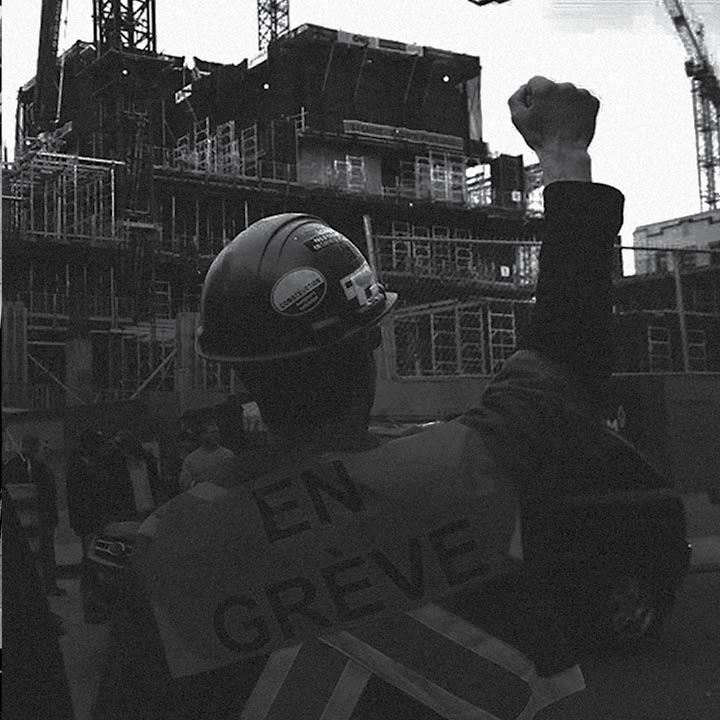
 (New) Communist Party of Canada / (Nouveau) Parti Communiste du Canada